How to Choose a Metal Detector Type
The right type of metal detector depends on your target and ground first, not on brand. Choose VLF for coins and relics in mild soil, pulse induction for wet sand and mineralized ground, and multi-frequency if you want one detector to handle both. Use a pinpointer only to narrow down a target after the main detector finds it.
On this page (14 sections)
- What detector type should you buy first?
- How does a VLF type of metal detector work best?
- When should you choose pulse induction instead?
- How do multi-frequency detectors change the choice?
- Which frequency range fits small gold and jewelry?
- How do you pick a type for beach and underwater hunting?
- What type fits gold prospecting and nugget hunting?
- When does imaging make sense as a detector type?
- How do you choose by screen, controls and learning curve?
- Which type fits relic hunting and old sites?
- What type should you buy for low budget, mid-range or premium use?
- How do you match detector type to your main target?
- More guides on this topic
- Final decision by detector type
The right type of metal detector is the one that matches your main target and the ground you will search most often. Start with VLF for general land hunting, pulse induction for wet or mineralized ground, and multi-frequency for mixed use.
A detector helps you tell metal from soil, trash and water, then narrow the spot where you dig. The type you pick sets those limits from day one.
This guide matches each type to hunting conditions and target needs. It also shows where pinpointer and imaging tools fit, so you do not pay for features you will rarely use.
What detector type should you buy first?
Buy the type that fits your most common search place, not a site you may visit once a year. Most buyers do best starting with VLF for parks, yards and fields.
VLF means Very Low Frequency. It sends a continuous signal and is strong on coins, jewelry and small relics.
It also gives target ID, tones and ground balance controls that help you learn fast.
Pulse induction, often called PI, sends short pulses and reads the decay. It handles salt water and hot ground well, but usually gives less target info.
Multi-frequency uses several frequencies at once. It aims to keep the coin sensitivity of VLF and the ground tolerance of PI in one machine, though it costs more.
If you mainly want to know what you can find before you buy, start with What Can You Find With a Metal Detector?.
How does a VLF type of metal detector work best?
A VLF detector works best when you hunt coins, jewelry and relics in mild to moderate soil. It gives clear target ID and tones, so you learn to skip iron and foil faster.
VLF units sample the ground in real time. That lets them ground balance out soil minerals and tell you if a target sounds like a coin or trash.
You get more info per sweep, which speeds up learning.
The trade-off is ground limits. Heavy salt, wet beach sand and very hot soil can make VLF noisy.
You can ground balance and lower sensitivity, but depth and stability may drop.
Frequency choice inside VLF also matters. Low frequencies favor depth on larger targets.
High frequencies favor small targets like gold and thin jewelry. A metal detector frequency chart helps you see that split in one place.
The Garrett ACE 400 bundle shows the VLF pattern well. It has a 0 to 99 digital target ID scale, iron audio to flag trash before you dig, and electronic pinpointing in non-motion all-metal mode.
It runs at 10 KHz and includes a carry case and searchcoil cover.
Rule: choose VLF when target info and learning curve matter more than wet-sand tolerance.
When should you choose pulse induction instead?
Choose pulse induction when wet sand, salt water or mineralized soil will be your main hunting ground. PI is less chatty on ground that overwhelms VLF.
A PI detector sends a pulse, then watches how fast that pulse fades. Metal makes it fade in a certain way, and the detector turns that fade into a signal.
PI usually gives little or no target ID. You will dig more nails, foil and wire to find good targets, but many beach hunters accept that cost because the detector keeps working where VLF struggles.
For a direct side-by-side of the two main types, read VLF vs Pulse Induction Metal Detectors: Which Should You Choose?. If PI already sounds right, When Should You Choose a Pulse Induction Metal Detector? goes deeper on beach and relic use.
How do multi-frequency detectors change the choice?
Multi-frequency detectors help when you hunt both land and wet ground with one machine. They send several frequencies together, so small and large targets both get a chance to respond.
A single-frequency VLF peaks at one target size. Multi-frequency spreads that peak across a wider range, so you may not get the absolute best depth on one target, but you avoid the worst miss on another.
This matters for mixed hunts. A park coin, a small gold ring and a wet-sand target all ask for different frequencies, and one unit can cover that mix without swapping machines.
The cost is real. Multi-frequency models sit at a higher price tier, and some controls feel less simple at first.
See Multi Frequency vs Single Frequency Metal Detectors: Which Should You Choose? before you pay the premium. Best Multi Frequency Metal Detectors lists options by features and use.
Which frequency range fits small gold and jewelry?
High frequency helps most for small gold, thin chains and tiny jewelry. Low frequency helps most for depth on larger silver and relics.
Mid frequency is the all-round middle.
Think of frequency as a size filter. High frequency energy reacts strongly to small, low-conductivity targets.
Gold is low conductivity, so it needs that push to stand out from soil.
Low frequency energy passes deeper and reacts well to larger, high-conductivity targets. That is why deep silver coins and large relics often favor lower settings.
Many detectors let you adjust frequency or run in a high-frequency mode. That does not turn a low-end coil into a specialty gold machine.
Coil size and ground balance still matter.
If gold is a main goal, Best High Frequency Metal Detectors shows which models lean that way. It also shows trade-offs in depth and trash handling.
Rule: match frequency to target size first, then check ground and coil options.
Low, mid and high frequency in plain use
Low frequency suits deep coins and large relics in mild soil. It gives up some sensitivity to small gold, so do not pick it only for nugget hunting.
Mid frequency suits general coin and jewelry hunting. It is the safest first choice if you do not yet know your main target.
High frequency suits small gold, fine jewelry and nuggets. It can chatter more on trash and mineralized soil, so ground balance matters.
Frequency and coil size together
A high-frequency detector with a large coil may still miss a small nugget at depth. A smaller coil can focus energy and help on small targets, but it covers less ground per sweep.
A large coil covers more ground and goes deeper on big targets. It also collects more ground signal, which can mean more noise in hot soil.
Pick coil size by target and site, not by habit. Small coils help in trashy, tight spots.
Large coils help in open, clean fields.
Rule: choose frequency for target size, then choose coil size for your site.
How do you pick a type for beach and underwater hunting?
For the beach, pick a type with waterproof protection and strong ground handling. The coil, shaft and control box all need to match where the water will reach.
A waterproof coil alone does not make a full detector submersible. Some coils can dip in wet sand while the control box stays dry.
Others are sealed for full underwater use.
Salt water adds a second problem. It is conductive, so it can mask targets and create false signals.
PI and multi-frequency types usually handle that signal better than basic VLF.
Sand itself is simpler than wet salt water. Dry sand is easy.
Wet sand near the waterline is where ground balance and recovery speed matter most.
The Bounty Hunter TK4 Tracker IV fits the entry all-terrain role. It has an 8 inch waterproof search coil and three detection modes: all-metal, tone and discrimination.
Bounty Hunter says it handles rocky, muddy or wet ground and suits coins, gold and relics.
It is made in the USA and carries IP54 protection. That rating helps with splashes and dust, but it is not the same as deep underwater sealing.
Rule: for regular water hunting, buy a sealed detector, not just a waterproof coil.
What type fits gold prospecting and nugget hunting?
Gold prospecting needs a type tuned for small, low-conductivity targets in mineralized soil. That usually means high frequency, a small to medium coil and strong ground balance.
Gold nuggets are small and often sit in soil with iron and other minerals. The detector must separate a weak gold signal from strong ground signal.
That is a hard job, and settings matter as much as type.
VLF gold machines with high frequency and ground balance often lead for nuggets. PI machines can also work, but they give less target info to help you reject hot rocks.
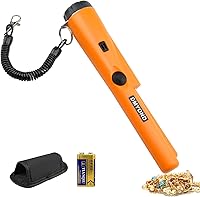
A pinpointer helps at the final step. Once the main detector finds a signal, a pinpointer narrows the spot inside the hole or in shallow water.
The Garrett Pro-Pointer AT is submersible to 20 feet and has three sensitivity levels. Garrett says max sensitivity helps on nuggets and other small targets.
It has fast retune to narrow the detection field and tune out mineralized ground. One-button control handles power, retune, sensitivity and stealth mode.
The bright orange case aids visibility, and a molded inch and centimeter ruler helps you judge depth.
Rule: for gold, buy ground balance and small-target sensitivity before you buy depth claims.
When does imaging make sense as a detector type?
Imaging makes sense when you need target shape or size before you dig. It does not make a detector find deeper or more gold by itself.
An imaging detector collects data across a grid and builds a picture of the target below. That picture can hint at size and shape, which can help on relic sites or large buried objects.
The cost is time and complexity. You sweep slower, set up a grid, and read a screen, while a standard detector with good pinpointing may find the same target faster.
Imaging also does not remove trash. It can show a shape, but shape alone does not prove value or age, so you still dig and inspect the find.
If imaging is central to your plan, How to Choose a 3D Imaging Metal Detector explains coils, grids and screen reading. Metal Detectors with Imaging: What to Look For covers what to check before you buy.
Imaging versus a screen with target ID
A simple target ID screen shows a number or icon for conductivity. It helps you decide to dig or skip.
An imaging screen shows a map of the target across the ground. It takes more sweeps and more skill to read.
Most coin hunters do well with target ID and tones. Imaging pays off only when pre-dig size and shape change your dig plan.
Rule: if you will not use the map to decide, do not pay for imaging.
How do you choose by screen, controls and learning curve?
Choose controls you will actually use on every hunt. A screen helps, but a simple control layout helps more when you are new.
Digital target ID gives you a number to learn. Tone ID gives you a sound to learn.
Both work, but they teach in different ways.
Analog controls, like the dials on the TK4, can be simple and fast. Digital menus can give more options, but they add steps and learning time.
Screens also drain batteries and can be hard to read in bright sun. Tones work well with headphones and in low light.
If you want models with displays, Best Metal Detectors With Screens compares that style. For VLF-focused options with strong ID, Best VLF Metal Detectors is a useful shortlist.
Rule: buy the interface you will learn fastest, not the one with more symbols.
Which type fits relic hunting and old sites?
Relic hunting favors a type with depth on larger targets and steady ground balance. Old sites often have iron, trash and mineralized soil mixed together.
Low to mid frequency VLF often leads for relics in fields and homesteads. It gives target info that helps you sort buttons, buckles and tools from nails and wire.
PI can help in very hot soil or near water, but it gives less info to sort relics from trash. At a trashy homestead, that lack of info can cost you many extra holes.
Coil choice matters here too. A larger coil helps in open fields.
A smaller coil helps around foundations, fences and iron trash.
Relic sites also reward patience. Slow sweeps, good ground balance and careful digging teach you more than a higher price tier.
Rule: for relics, prioritize ground balance and target info over raw depth claims.
What type should you buy for low budget, mid-range or premium use?
Budget still works if you match the type to one clear job. A simple VLF or all-terrain detector can teach you the hobby for parks and yards.
Mid-range money buys better target ID, ground balance, coils and bundles. That is where many first detectors start to feel complete.
Premium money buys multi-frequency, better waterproofing, imaging or specialty gold tuning. Those features pay off only if your sites need them.
A pinpointer is often a smart add-on at any budget. It saves digging time and helps you learn target depth and shape faster.
The ACE 400 bundle is a mid-range example with target ID, iron audio and a pinpointer included. The TK4 is a simpler all-terrain example with analog controls and an 8 inch waterproof coil.
Rule: spend on ground handling and recovery tools before you spend on specialty types.
How do you match detector type to your main target?
Match type to target size, conductivity and depth in that order. Size and conductivity decide frequency.
Depth needs coil size and ground balance. Type ties those together.
Coins are small and high conductivity. Mid-frequency VLF with target ID is a strong start.
Jewelry is small and varied in conductivity. Mid to high frequency helps, and tones help you hear subtle changes.
Gold nuggets are small and low conductivity. High frequency and ground balance matter most, with a pinpointer for recovery.
Relics are often larger. Low to mid frequency, a larger coil and good iron handling help.
Trashy or wet sites change the order. Ground handling can matter more than target size, which is why PI and multi-frequency exist.
If you are still sure of your use, What Is a Metal Detector Used For? The Basics gives a plain overview of jobs and tools.
Rule: name one main target, then buy the type that finds that target best in your ground.
More guides on this topic
Final decision by detector type
The best type of metal detector for you is the one that fits your main target, your ground and your budget without extra features you will skip. VLF remains the best first type for most land hunters.
Choose VLF for coins, jewelry and relics in mild soil. Choose pulse induction for wet sand, salt water and hot ground.
Choose multi-frequency for mixed land and water use with one machine.
Add a pinpointer if recovery time matters. Add imaging only if pre-dig shape will change your dig plan.
Add a high-frequency gold model only if small gold is a main goal.
Start with one clear target and one real site. That focus will teach you signals faster than a long feature list ever will.
Final rule: buy VLF for land, PI for wet ground, multi-frequency for mixed use, and a pinpointer for faster recovery.
Frequently asked questions
What type of metal detector is best for beginners?
A mid-frequency VLF detector with simple controls and target ID usually suits beginners best. It handles coins, jewelry and common trash in parks and yards, and it teaches you how signals change with depth.
Start with one solid VLF model before adding specialty types.
Is a pinpointer a type of metal detector?
A pinpointer is a small detector made for final pinpointing, not for wide searching. It helps you find a target quickly inside a hole or in shallow water.
You still need a main detector to scan the area first and tell you where to dig.
Which detector type works best on the beach?
Pulse induction and multi-frequency detectors usually handle wet sand and salt well. VLF models can work too if they have ground balance and waterproof coils.
Check the coil rating and ground handling before you buy for beach use.
Do I need an imaging detector?
Only if you need a shape or size estimate before you dig. Imaging adds cost and complexity, and it does not replace good ground handling.
Most coin, jewelry and relic hunters do well with VLF or multi-frequency models.