9 Best Sluice Boxes for Beginners (November 2026)
The best beginner sluice boxes include the ASR Outdoor Lightweight Backpack Gold Panning Kit for an all-in-one start, the Gold Panning Kit with 12" Pocket Sluice for sampling and family use, and the VEVOR Complete Sluice Box Gold Panning Kit for a longer first sluice.
On this page (5 sections)
The best sluice box for beginners is the ASR Outdoor Lightweight Backpack Gold Panning Kit because it combines a 12 in mini sluice with pans, a sifter and field tools. That mix suits a first trip because you can classify material, run a small sluice and inspect what settles without buying separate pieces.
Pick VEVOR when you want a 50 in folding sluice, or choose Dream Mat when powered cleanup suits your workspace. Think about where you will work before you decide, because each option answers a different situation.
A first sluice should match your access, water source and expected material load. A short walk to a creek calls for a different kit than a drive to a gravel bar with a truck bed nearby.
Pocket models are easy to carry and useful for sampling, while longer aluminum boxes give more channel length but need more room and setup. The trade-off shows up in how much material you can feed and how much gear you must haul.
Your skill level matters as much as size. A beginner learning flow control may get more from a small sluice and small batches than from a long box fed too fast.
The ASR Outdoor setup also fits people who want one bag for a weekend outing. Its drawstring backpack keeps pans, tools and the mini sluice together.
If you plan to work at home after a trip, a powered cleanup setup may suit you better than a stream sluice. Adjustable water flow makes it easier to learn how material moves through matting.
If you already own pans and a classifier, you may not need a full kit. A standalone pocket sluice can fill the gap while avoiding duplicate tools.
If you are still building your kit, our guide to gold panning equipment covers tools that make a first trip easier. Read it with your planned water source in mind.
Start with a site you can reach easily and a sluice you can set up without struggle. That first session will teach flow, feeding and cleanup better than any spec list.
Take notes on water speed, material size and how often you clear the sluice. Those notes will help you choose better next time.
Pack the bag the night before and check that pans, sifter and collection tools are inside. Rinse gear after use and let small parts dry before storage.
Our picks at a glance
-
1
 Best for an all-in-one start
ASR Outdoor Lightweight Backpack Gold Panning Kit
9.7/10 our score
See it on Amazon -
2
 Best for sampling and family use
Gold Panning Kit with 12" Pocket Sluice
9.7/10 our score
See it on Amazon -
3
 Best for a longer first sluice
VEVOR Complete Sluice Box Gold Panning Kit
9.6/10 our score
See it on Amazon
- 4
 Check it
DigNew 18pcs Mini Sluice Box Gold Panning
Best for a guided mini setup - 5
 Best for powered cleanupCheck it
- 6
 Check it
ASR Outdoor Rubber Riffled Gold Sluice Box
Best for custom mat fitting - 7
 Best for remote samplingCheck it
- 8
 Check it
WodGod 18pc Gold Panning Kit with Mini
Best for a folding starter kit - 9
 Check it
SE Professional Pocket-Sized Sluice Box with 3
Best for the simplest pocket tool
Which sluice box is best for a beginner?
The best overall beginner choice is the ASR Outdoor kit because it includes a compact sluice and tools for basic field work. It suits someone who wants to learn the full sequence in one purchase.
The Sluice Fox kit is a strong option for sampling and teaching, while VEVOR suits buyers who want a longer folding setup. Those picks differ mainly in size, carrying effort and expected material.
Our score weighs specs, features and buyer feedback against what you are shopping for. We checked dimensions, materials, kit contents, portability and learning fit, then ranked products from highest score to lowest.
That approach keeps the ranking tied to practical beginner use. A product can score well for portability while another scores well for channel length, and your site decides which matters more.
Size is often the first decision. A 12 in mini sluice fits tight spots and short walks, while a 50 in folding sluice needs more room and effort to carry.
Kit contents are next. Pans, classifiers, scoops and small collection tools can simplify a first trip because you do not need a second shopping list.
Material affects care and handling. Rubber, aluminum and plastic suit different habits, from rolling a mat to wiping down a metal channel after a wet day.
Compare these products against your planned routine. That is the fastest way to avoid buying a sluice for a job it was not built to do.
| Product | Best for | Sluice size | Material | Kit size | Our score |
|---|---|---|---|---|---|
| ASR Outdoor Lightweight Backpack Gold Panning Kit | an all-in-one start | 12 in | TPR rubber | 14 pieces | 9.7 |
| Gold Panning Kit with 12" Pocket Sluice | sampling and family use | 12 x 4 x 3 in | 9.7 | ||
| VEVOR Complete Sluice Box Gold Panning Kit | a longer first sluice | Hard-anodized aluminum | 23 pieces | 9.6 | |
| DigNew 18pcs Mini Sluice Box Gold Panning | a guided mini setup | 12 x 3.7 x 1.6 in | Aircraft-grade aluminum | 18 pieces | 9.6 |
| Dream Mat Clean-Up Buddy Kit | powered cleanup | 9.6 | |||
| ASR Outdoor Rubber Riffled Gold Sluice Box | custom mat fitting | TPR rubber | 9.2 | ||
| Pocket Gold Sluice Box | remote sampling | Aluminum | 9.1 | ||
| WodGod 18pc Gold Panning Kit with Mini | a folding starter kit | Metal | 18 pieces | 8.2 | |
| SE Professional Pocket-Sized Sluice Box with 3 | the simplest pocket tool | Plastic | 8.1 |
Best beginner sluice boxes compared
The products below cover three common starting points: complete kits, pocket sluices and cleanup systems. Read the short write-ups with your planned water source and carrying distance in mind.
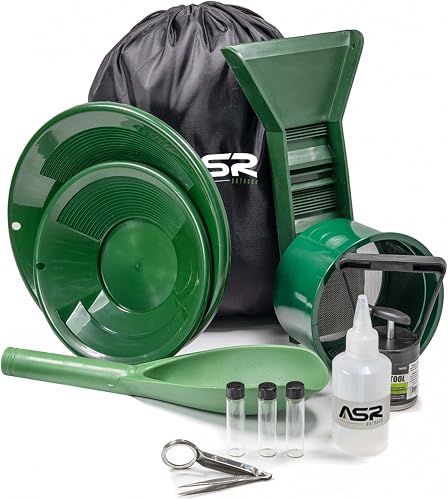
ASR Outdoor Lightweight Backpack Gold Panning Kit: Best for an all-in-one start
- 12 in mini rubber sluice box
- 14-piece kit
- 10 in and 12 in dual riffle pans
- 30 holes/in sifter
The compact kit combines a 12 in TPR rubber sluice with pans, a sifter, a scoop, a magnet tool, tweezers and storage gear. The drawstring backpack keeps the field setup together.
Pros
- Portable 14-piece setup
- Three built-in riffle patterns
- Includes pans and sifter
Cons
- Mini sluice has less processing room than a full-size model
The ASR Outdoor kit is the easiest all-around starting point for a beginner who does not want to gather every small tool separately. Its 12 in TPR rubber mini sluice has 3 built-in riffle patterns and needs no tools or assembly.
The 14-piece setup includes 10 in and 12 in dual riffle pans, a brass probe scoop, a black sand magnet tool, tweezers, a 30 holes/in sifter and a drawstring backpack. Those pieces cover classifying, moving material, checking concentrates and carrying the kit to a stream.
The backpack format also makes the kit easier to organize between trips. Its 2 lb weight is reasonable for a short walk, but the 12 in sluice still limits how much material you can process at one time.
Choose it if you want one compact kit for learning and field sampling. For the basic recovery process, see our guide on how does a sluice box work.
Gold Panning Kit with 12" Pocket Sluice: Best for sampling and family use
- 12 in pocket sluice
- Rubber riffle mat and miners moss
- 9 in and 11 in spiral riffle pans
- Manual operation
This Sluice Fox kit pairs a 12 in pocket sluice with spiral riffle pans for sampling gravel bars, cleanup work and teaching the basics. Its manual design keeps the setup simple.
Pros
- Pocket-sized sluice
- Two spiral riffle pans
- Useful sampling focus
Cons
- Small sluice is not designed for large processing runs
The Sluice Fox kit suits a beginner who wants to sample a gravel bar, clean up concentrates or show children how a sluice works. Its 12 in pocket sluice uses a rubber riffle mat and miners moss to hold heavier material.
That format tests a spot before bringing bigger gear. A small sluice can run a modest amount of classified material and give a clearer picture of what a site may hold.
The kit includes 9 in and 11 in spiral riffle pans. Their deep walls and aggressive spiral riffles move lighter material while retaining fine flakes during panning.
Two pan sizes help with different tasks. A larger pan handles more material at the start, while a smaller pan makes finishing and inspecting concentrates easier.
The compact 12 x 4 x 3 in size is easy to carry, and manual operation keeps the setup independent of electricity. You need no pump or outlet, which suits creek banks and family outings.
It is still a small sluice, so large amounts of pay dirt take more time. That limit is the main trade-off for a big batch.
Pick it for sampling and simple family learning. If fine gold is your main concern, compare it with our best sluice box for fine gold guide.
VEVOR Complete Sluice Box Gold Panning Kit: Best for a longer first sluice
- 50 in folding sluice
- 23-piece kit
- Hard-anodized aluminum
- Pre-installed miner's moss
The 50 in folding sluice gives a beginner more channel length while the 23-piece kit covers pans, screens, a magnet, collection bottles and other tools. Its 11.7 lb weight matters for longer walks.
Pros
- Longest sluice here
- 23 pieces included
- Folding structure with storage bag
Cons
- Heavier and larger than pocket kits
VEVOR is the strongest choice here for a beginner who wants a longer sluice without assembling a separate collection of tools. The 50 in folding aluminum alloy sluice gives material more channel length than the mini and pocket options.
More channel length can make each run steadier because material has more room to settle as it moves. That suits a beginner who wants to run larger batches than a 12 in sluice can handle comfortably.
Its 23-piece kit includes 2 gold pans, 2 classifier screens, a separating magnet, 3 snuffer bottles, 3 pipettes, 3 gold vials, a paydirt scoop, a spoon, magnifier tweezers, 4 crevice picks and a drawstring backpack. The range covers classifying, moving material and collecting small finds for closer inspection.
The sluice is made from hard-anodized aluminum and comes with pre-installed miner's moss. The folding structure helps with storage, and the storage bag keeps the setup together between trips.
The 11.7 lb weight is the main trade-off, especially when walking to a remote creek. Add water, material and extra tools, and the carry becomes a real part of the plan.
Choose it if your priority is more sluice length and a broad starter kit. Our best large sluice box guide covers when a longer design makes sense.
DigNew 18pcs Mini Sluice Box Gold Panning: Best for a guided mini setup
- 12 in mini sluice
- 18-piece kit
- Aircraft-grade aluminum
- Dual-layer miner's moss
DigNew gives beginners a 12 in aluminum sluice plus pans, classifier screens, collection tools and a backpack. The included user manual adds structure for learning the basic sequence.
Pros
- 18-piece setup
- Compact aluminum sluice
- Includes user manual
Cons
- Mini channel limits the amount processed at once
DigNew gives beginners a compact aluminum setup with more accessories than a basic pocket sluice. Its 12 in mini sluice is 3.7 in wide and 1.6 in high, with aircraft-grade aluminum construction.
That size suits short walks and tight creek spots where a longer box would be hard to place. The narrow channel also makes it easier to give small batches your full attention while you learn.
The 18-piece kit includes 2 gold pans, 2 classifier screens, magnifier tweezers, a separating magnet, 3 snuffer bottles, 3 storage vials, 3 pipettes, a paydirt scoop and a drawstring backpack. A user manual explains the included panning accessories.
The manual can help a first user follow a clear order from classifying to collection. That structure is useful if you are still learning which tool to use at each stage.
The smaller channel keeps the kit manageable for learning, but it also means slower work when you have a large amount of material. Use it for small batches and practice rather than treating it like a full production sluice.
Pick DigNew for a guided mini kit with many collection accessories.
Dream Mat Clean-Up Buddy Kit: Best for powered cleanup
- Banjo Micro Dream mat
- Adjustable 400 GPH pump
- 3D-printed sluice with stand
- 110 V AC power
The Clean-Up Buddy is a small cleanup system with a stand, Banjo Micro Dream mat and adjustable 400 GPH pump. It suits beginners who have access to AC power and want controlled water flow.
Pros
- Adjustable pump flow
- Compact cleanup format
- Includes stand and mat
Cons
- AC power limits remote stream use
Dream Mat's Clean-Up Buddy is different from the other beginner picks because it uses an adjustable 400 GPH 110 V AC pump. The kit includes a 3D-printed sluice with stand and a Banjo Micro Dream mat.
That setup suits a home or workshop station where you can plug in power and control the flow. It is a cleanup system first, not a pack-and-go stream sluice.
Its 12.5 x 5.5 x 7 in size suits a home or workshop cleanup station. The adjustable flow lets you change the water speed for different material sizes, but the AC power requirement makes it less suitable for a remote stream.
Adjustable flow can help you learn how water speed affects matting and settling. You can slow the flow for fine material or raise it when you need to move lighter sand through.
The plastic body should be stored away from direct sunlight and heat. That care point matters because the system is intended to stay in service as a compact cleanup tool.
Keep the stand stable on a flat surface and rinse the mat after use. Those simple habits help the mat and pump stay ready for the next cleanup session.
Choose it for powered concentrate cleanup, not as a replacement for a portable stream setup. For mat-specific operation, read how to use a Dream Mat sluice.
ASR Outdoor Rubber Riffled Gold Sluice Box: Best for custom mat fitting
- 27 x 10 in TPR rubber mat
- Three riffle patterns
- Pre-scored trim guide
- Flexible in cold weather
This is replacement sluice matting rather than a complete sluice box. Its Hungarian, V-shape and square riffle patterns let a beginner adapt mat coverage to a compatible box.
Pros
- Three trap patterns
- Can be cut to 8 in width
- Flexible TPR material
Cons
- Requires a separate sluice box
The ASR Outdoor rubber mat is a useful upgrade when you already have a compatible sluice box. It measures 27 x 10 in, uses flexible TPR rubber and has 3 riffle patterns: Hungarian, V-shape and square.
That size gives you more coverage than a small pocket mat, which can suit a longer box. It can also be trimmed when a narrower channel needs a closer fit.
The mat is pre-scored so it can be cut to 8 in wide. That gives you a way to fit it to a narrower box, but you should measure the box before cutting.
Measure twice and cut once, because a trimmed mat cannot be stretched back to full width. Keep the cut edge straight so the mat sits flat in the channel.
The Hungarian pattern increases turbulence behind the riffle, the V-shape grooves suit fine gold flake and the square grooves are intended for small finds and nuggets. Those options make it more adjustable than a single-pattern mat.
You can match the pattern to the material and water you expect. Fine flakes call for one setup, while larger particles may suit a different groove pattern.
The flexible rubber is also easier to roll for storage than a rigid mat. Rinse it after use and dry it before rolling it away.
Choose it for custom mat fitting and recovery setup changes. It is not a complete sluice, so you still need the box and other tools.
Pocket Gold Sluice Box: Best for remote sampling
- 12 in pocket sluice
- Aluminum construction
- Miner's moss and V-Trap matting
- Expanded metal
The Sluice Fox pocket sluice weighs 14.4 oz and includes expanded metal with Miner's Moss and V-Trap matting. It fits beginners who want to sample tight creeks and remote spots.
Pros
- Lightweight sampling tool
- Two matting options
- Compact 12 in length
Cons
- Only the pocket sluice is included
The Sluice Fox Pocket Gold Sluice is a strong remote sampling tool because it weighs 14.4 oz and measures 12 in long. Its aluminum construction keeps the design light for tight creeks, tributaries and bedrock areas.
That weight makes it easy to carry on a scouting walk or tuck into a larger bag. Sampling often means moving between spots, so lightness can matter more than channel length.
The metal version includes expanded metal with both Miner's Moss and V-Trap matting. Having two matting options lets you choose a setup for the water flow and material you encounter.
You can swap matting as conditions change, which helps when one spot has fine material and another has coarser gravel. That choice gives a small sluice more range.
The package contains the pocket sluice, so it is best for a beginner who already owns a pan, classifier and collection tools. Its small format makes cleanup easier, but it cannot match the throughput of a longer sluice.
For a first purchase, check what you already own before adding this piece. Duplicating pans or classifiers may not help your first trip.
Pick it for lightweight sampling and home cleanup. See our guide to the best folding sluice box if you want more length without giving up portability.
WodGod 18pc Gold Panning Kit with Mini: Best for a folding starter kit
- 27.5 in folding sluice
- 18-piece kit
- 6000-series aluminum
- Pans, screens and backpack
WodGod gives beginners a folding 27.5 in sluice and a broad accessory set with pans, screens, a magnet, bottles and a backpack. It offers more channel length than pocket models while remaining foldable.
Pros
- Folding 27.5 in sluice
- 18-piece kit
- Includes a user manual
Cons
- Lower score reflects fewer confirmed details for comparing the setup
WodGod offers a middle ground between pocket tools and the 50 in VEVOR. Its 27.5 in folding sluice uses metal construction and packs into the included drawstring bag.
That length gives you more working room than a 12 in mini sluice. It also folds down for transport, which helps if you drive to a site and walk the last stretch with your kit.
The 18-piece kit includes 2 gold pans, 2 classifier screens, magnifier tweezers, a separating magnet, 3 snuffer bottles, 3 storage vials, 3 pipettes, a paydirt scoop and a backpack. The kit also includes a user manual for beginners.
The manual can help you use the screens and pans in a sensible order. That guidance may shorten the learning curve for a first season.
The longer channel gives you more room than a 12 in mini sluice, while the folding design helps with transport. The product data identifies the material as metal, so compare the carrying weight with your hiking plans before choosing it.
Check the folded size against your bag or vehicle space before you buy. A sluice that fits your pack is easier to use on a regular basis.
Pick WodGod for a foldable mid-size starter kit.
SE Professional Pocket-Sized Sluice Box with 3: Best for the simplest pocket tool
- 12 in pocket sluice
- Three riffle types
- 3 in channel width
- Water-resistant construction
SE keeps the learning setup focused on one 12 in pocket sluice with three riffle patterns. It suits a beginner who already has pans and collection tools.
Pros
- Simple one-piece setup
- Three riffle patterns
- Fits a pocket or bag
Cons
- Does not include a full panning kit
SE is the simplest choice for a beginner who already has the rest of the panning equipment. This 12 in pocket-sized sluice is 3 in wide with 1.5 in channel walls and 3 riffle types: Hungarian, V-shape and square.
That simple setup suits a learner who wants to focus on sluice flow without a long list of new tools. It also fits a pack or travel bag for short scouting trips.
The plastic construction is water resistant, and the box includes one GP-SB36PT sluice. Its compact size fits a pocket, backpack or travel bag, and a lanyard hole gives you another carrying option.
The lanyard hole can help when you want to attach the sluice to gear for a short carry. It is a small detail that suits sampling where you move often.
Because it is a single sluice rather than a complete kit, you will need a pan and other tools for a full trip. That narrow scope is useful if you want to learn sluice flow without buying duplicate accessories.
Make sure your pan, classifier and collection tools are ready before you go. A single sluice works best as part of a kit you already own.
Choose it for the most focused pocket setup.
How should a beginner choose a sluice box?
Choose a sluice box by processing size, carrying distance, water access and the tools you already own. A complete kit saves extra shopping, while a standalone pocket sluice can be the better value when your pans and classifier are ready.
Pocket or full-size sluice?
A pocket sluice is best for sampling narrow creeks, remote gravel bars and small batches. The 12 in ASR Outdoor, Sluice Fox and SE models are easier to carry, but they give you less channel length for each run.
That trade-off suits scouting, where you want to test a spot quickly and move on. It also suits a beginner who wants to learn water flow with small amounts of material.
A longer sluice can handle a larger working load, but it needs a better stream position and more transport effort. The 50 in VEVOR is the largest option here, while WodGod sits between the pocket and full-size choices at 27.5 in.
Think about the walk in and the space at the water before you choose length. A longer box is only better if you can place it well and feed it steadily.
Aluminum, rubber or plastic?
Aluminum gives the DigNew, VEVOR and Sluice Fox metal models a firm structure. TPR rubber, used by ASR Outdoor and the ASR Outdoor mat, stays flexible and is easier to roll or fit, while SE uses plastic for its pocket sluice.
Material alone does not decide the best fit. Compare the size, weight, included matting and whether you need to cut or replace the mat.
What other tools do beginners need?
You generally need a pan, classifier or screen, scoop, snuffer bottle and a way to inspect or store recovered material. Complete kits such as ASR Outdoor, VEVOR, DigNew and WodGod combine many of these pieces.
Start with manageable amounts of classified material. Feed slowly, keep the box stable in moving water and inspect the concentrate during cleanup instead of assuming every visible flake is gold.
How do you set up a beginner sluice box?
Set the sluice in steady moving water, keep the channel stable and feed classified material in small amounts. Angle and water speed depend on box, matting and material, so adjust while watching light sand move through riffles.
Start by clearing large rocks before feeding. That keeps the channel from clogging and lets you focus on flow.
Place the box so water enters evenly across the width. Uneven entry can push material to one side and make settling harder to read.
Guide material in a steady stream rather than dumping a full bucket at once. Slow feeding gives riffles and mat time to hold heavier particles.
Watch the first few minutes for signs water is too fast or too slow. A small angle change can clearly affect how sand moves.
If sand rushes through too quickly, ease flow or feed less. If material piles up, check the box is stable and not blocked.
Rinse sluice and mat after use, then inspect trapped concentrate in a pan or cleanup system. Dry parts before storage, and keep the Dream Mat Clean-Up Buddy away from direct sunlight and heat.
Rinsing removes sand that can scratch surfaces or hide small finds next time. Store small tools in their bag or case where possible.
Never assume a small sluice can process unlimited material. Slow feeding helps you learn flow and reduces washing useful material through.
Which is the best sluice box for beginners?
The ASR Outdoor Lightweight Backpack Gold Panning Kit is the best sluice box for beginners who want a portable, complete starting setup. It combines a 12 in rubber sluice with pans, a sifter and field tools.
That format suits a first season because you can learn classifying, sluicing and cleanup with one bag. You do not need to guess which small tools to buy before your first trip.
Choose Sluice Fox for sampling and teaching. Pick DigNew for an 18-piece mini kit, VEVOR for a 50 in folding sluice, WodGod for a mid-size folding setup, and Dream Mat for powered cleanup.
Each pick fits a different routine, so match the sluice to site and water source. A pocket model suits scouting, while a powered setup suits a home station.
If you walk far, weight and folded size should lead your choice. A lighter kit is easier to carry, set up and pack out.
If you drive to a gravel bar and stay in one spot, a longer sluice may give more room. Extra length helps with a larger batch of classified material.
If you already own pans and a classifier, a standalone pocket sluice may be smarter. You can buy the tool you need instead of duplicating gear.
If you are comparing a detector hobby with prospecting, our guide to Is Metal Detecting a Real Hobby? A Beginner’s Guide explains how activities differ.
You can also learn another detector component in What Is a Metal Detector Control Box? A Simple Guide.
Our top 3 picks at a glance
-
1
Best for an all-in-one start
ASR Outdoor Lightweight Backpack Gold Panning Kit
9.7/10 our score
See it on Amazon -
2
Best for sampling and family use
Gold Panning Kit with 12" Pocket Sluice
9.7/10 our score
See it on Amazon -
3
Best for a longer first sluice
VEVOR Complete Sluice Box Gold Panning Kit
9.6/10 our score
See it on Amazon
Frequently asked questions
What is the best sluice box for beginners?
The ASR Outdoor Lightweight Backpack Gold Panning Kit is the best sluice box for beginners who want a complete portable setup. It includes a 12 in TPR rubber sluice, 2 pans, a sifter, a scoop, a magnet tool, tweezers and storage gear.
Choose a longer folding model if you plan to process more material.
What size sluice box should a beginner use?
A 12 in pocket or mini sluice is a practical starting size for sampling, learning water flow and working in tight areas. A 27.5 in or 50 in folding sluice gives you more channel length but adds more carrying and setup work.
Match the size to your access and the amount of material you expect to process.
Do beginners need a complete gold panning kit?
A complete kit can make the first trip easier because it may combine a sluice, pans, classifier, scoop and gold collection tools. The ASR Outdoor, Sluice Fox, VEVOR, DigNew and WodGod kits include several supporting items.
If you already own pans and a classifier, a pocket sluice may be enough.
Can a beginner use a pocket sluice box?
Yes. A pocket sluice can help you sample a gravel bar, test a narrow creek or clean up concentrates.
Feed material slowly into moving water and watch how the riffles and mat hold heavier material.
Pocket sluices process less material than longer boxes, so they work best for scouting and small cleanups.
What should beginners learn before using a sluice?
Beginners should learn how water flow, riffles, matting and material classification work together. Start with small amounts, remove large rocks before feeding material and inspect the concentrate during cleanup.
Our guide to how does a sluice box work explains the basic process.