6 Best Gold Classifier for 5 Gallon Bucket (November 2026)
The best gold classifiers for 5 gallon buckets include the SE Tool 1/4" Classifier Sifting Pan Gold Panning for simple bucket screening, the SE 13.25 Inch Wide Stackable Classifier Gold for several mesh sizes, and the ASR Outdoor 11pc Gold Panning Kit with for a complete starter setup.
On this page (7 sections)
- The best gold classifiers for 5 gallon buckets
- How to choose a gold classifier for a 5 gallon bucket
- Should you buy one screen or several gold classifiers?
- How to use a 5 gallon bucket gold classifier
- How to handle black sand after classification
- Care and storage for gold classifiers
- Which gold classifier is best for your bucket setup?
The best gold classifier for a 5 gallon bucket is the SE Tool 1/4 inch Classifier Sifting Pan for most prospectors.
Its stainless steel screen fits a 5 gallon bucket and removes coarse overburden before smaller material goes to a gold pan.
That simple step changes the work that follows.
A classifier sorts by size, so it removes large rocks and worn gravel first.
What remains is smaller and more consistent, which makes panning easier to judge and control.
Without it, you spend more time moving bulky stones that do not belong in the pan stage.
Choose the SE 5-piece set if you want several mesh sizes. Pick an ASR kit if you need classifiers, gold pans and recovery tools together.
Your choice depends on the screen opening, the amount of material you process, and whether you already own the rest of your gold panning equipment.
A coarse screen works quickly on rocky loads, while a finer screen leaves a smaller fraction for closer work.
A full-size classifier on a bucket rim also simplifies daily use.
You can load a measured amount, shake or wash it, and let the bucket catch what passes through.
That free-hand setup is steadier than holding a screen through load after load.
It also keeps sifted material in one place, ready to carry to the pan.
The SE Tool suits a prospector who already has a pan and recovery tools and mainly needs screening.
Think about your usual ground first, then match the screen to the material you handle most often.
If loads vary between coarse gravel and finer sand, a multi-size set avoids using the wrong opening.
If loads stay much the same, one well-chosen screen keeps gear light and routine simple.
Our picks at a glance
-
1
 Best for simple bucket screening
SE Tool 1/4" Classifier Sifting Pan Gold Panning
9.7/10 our score
See it on Amazon -
2
 Best for several mesh sizes
SE 13.25 Inch Wide Stackable Classifier Gold
9.6/10 our score
See it on Amazon -
3
 Best for a complete starter setup
ASR Outdoor 11pc Gold Panning Kit with
9.2/10 our score
See it on Amazon
- 4
 Check it
SE 5.5 Inch Mini Stackable Classifier Gold
Best for compact prospecting gear - 5
 Check it
Stansport Gold Panning Classifier
Best for 3/8 inch screening - 6
 Check it
ASR Outdoor 19pc Ultimate Gold Panning Kit
Best for group prospecting
The best gold classifiers for 5 gallon buckets
The best gold classifiers for 5 gallon buckets fall into 3 groups: single-screen tools, stackable screen sets and complete panning kits. Single screens cost less space in your gear, while sets give you more control over material size.
SE Tool 1/4" Classifier Sifting Pan Gold Panning: Best for simple bucket screening
- 1/4 inch square stainless steel mesh
- Fits a 5 gallon bucket
- Sifting pan design
This classifier keeps the setup simple with one 1/4 inch stainless steel screen that fits a 5 gallon bucket. It suits prospectors who already own a pan and only need to remove coarse overburden.
Pros
- Fits a 5 gallon bucket
- Stainless steel mesh
- Useful 1/4 inch opening
Cons
- Only one mesh size
- Does not include gold pans or recovery tools
The SE Tool 1/4 inch classifier is the strongest single-screen choice in this roundup. Its 1/4 inch square stainless steel mesh is fine enough to remove a wide range of gravel while allowing smaller material to pass through.
The pan fits a 5 gallon bucket, which gives you a simple way to screen collected material without holding the classifier in your hands. That setup can be useful when you are processing several loads and want the bucket to catch the sifted material.
This is a good match for a prospector who already owns a gold pan, scoop and recovery tools. The trade-off is that you get only one mesh size, so you cannot switch to a coarse first pass or a finer finishing screen without another classifier.
Choose it when you want a focused tool for ordinary bucket screening. For more detail on mesh choices, compare this screen with our guide to an arbor fabricating gold classifier.
SE 13.25 Inch Wide Stackable Classifier Gold: Best for several mesh sizes
- 5 stackable pans
- 1/2, 1/4, 1/8, 0.083 and 0.050 inch mesh
- Stainless steel wire mesh
- Fits a 5 gallon bucket
Five stackable screens let you sort material in stages, from coarse gravel to finer material. Choose this set when one mesh size would limit the deposits you work.
Pros
- Five mesh sizes
- Stackable design
- Fits a 5 gallon bucket
Cons
- More pieces to carry
- Higher weight than a single screen
The SE 13.25 inch stackable set is the best choice when you want to classify material through several stages. It includes 5 pans with 1/2, 1/4, 1/8, 0.083 and 0.050 inch mesh.
Each pan fits on a 5 gallon bucket, and the stackable design keeps the screens together while you work. Start with the larger opening, then move smaller material through finer screens when the deposit calls for more separation.
The stainless steel wire mesh gives the set a broad range of uses for gravel, soil and pay dirt. The 5-piece format also helps when different people want to work with different mesh sizes.
The trade-off is extra weight and more pieces to rinse, dry and store. If you only need one general-purpose screen, the SE Tool classifier is simpler.
Read what is a gold panning classifier before choosing a mesh sequence for your material.
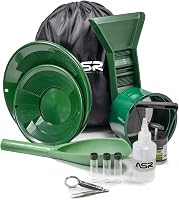
ASR Outdoor 11pc Gold Panning Kit with: Best for a complete starter setup
- 1/2 and 1/8 inch classifier screens
- 2 10 inch gold pans
- 14 inch and 8 inch gold pans
- Scoop, snifter bottle and storage vials
This kit combines two classifier screens with gold pans and basic recovery tools. It fits a beginner who needs more than a screen and wants coarse and fine classification in one set.
Pros
- Includes 2 classifier screens
- Includes several gold pans
- Includes storage and recovery tools
Cons
- Only 1/2 and 1/8 inch screens
- More gear than a screen-only buyer needs
The ASR Outdoor 11-piece kit suits a beginner who needs a classifier and the basic tools that follow it. It includes 1/2 and 1/8 inch classifier screens, 2 10 inch gold pans, a 14 inch pan, an 8 inch pan, a scoop, a snifter bottle, magnifying tweezers and 2 glass storage vials.
The two screen sizes create a simple coarse-to-fine workflow. Use the 1/2 inch screen to remove larger rocks, then use the 1/8 inch screen to prepare smaller material for panning.
The screens are designed to stack on a 5 gallon bucket. The kit also includes pans for different stages of panning, so it can cover more of a beginner's setup than a screen-only purchase.
The trade-off is that the mesh choices are limited to 1/2 and 1/8 inch. Choose another pick if you want 1/4 inch screening or a full set of finer openings.
SE 5.5 Inch Mini Stackable Classifier Gold: Best for compact prospecting gear
- 5.5 inch size
- 10 holes per square inch
- Stainless steel mesh
- Green plastic stackable design
The mini classifier takes less room than a full-size screen and suits small sampling jobs. Pick it when portability matters more than processing a large amount of pay dirt at once.
Pros
- Compact 5.5 inch size
- Stainless steel mesh
- Stackable design
Cons
- Small screening area
- Mesh is described by holes per square inch
The SE 5.5 inch mini classifier is the compact choice for small samples and limited gear space.
Its 5.5 x 5.5 x 3.5 inch body uses stainless steel mesh described as 10 holes per square inch.
The green plastic stackable design makes it easy to add to a small prospecting kit.
It suits a reader who samples material rather than screening large amounts of pay dirt at a time.
At 3.68 ounces, it is light enough to carry in a side pocket or a small bag with a pan.
That weight makes it a practical option for short trips, day hikes, or places where you test a few shovels of material before committing to more work.
The mesh description is worth attention in daily use.
Ten holes per square inch gives you a fine pattern for a compact screen, though it works differently from a classifier labeled by a specific opening size.
You may need to check how your material moves through it, since the pattern and wire thickness shape the flow more than the label alone suggests.
Its small size is also the main limitation.
A 5.5 inch screen processes less material per pass than a full-size classifier, so it may take longer when you have a large bucket to sort.
For sampling, that pace can be fine, because you are looking for signs in a small amount of ground.
For bulk work, the same pace becomes a burden, as you refill the screen again and again while larger material builds up on top.
The stackable form helps with storage, but a single mini pan still gives you only one screening stage.
Choose it for portability and sampling.
Choose the SE Tool or Stansport classifier when a full-size screen is more important.
Stansport Gold Panning Classifier: Best for 3/8 inch screening
- 3/8 inch mesh
- Lightweight plastic body
- Fits a 5 gallon bucket
The 3/8 inch mesh sits between coarse 1/2 inch screening and finer 1/4 inch screening. It is a straightforward choice for removing larger rocks while allowing smaller material through.
Pros
- Fits a 5 gallon bucket
- Lightweight plastic
- 3/8 inch opening
Cons
- One mesh size
- Less fine than a 1/4 inch screen
The Stansport classifier is a straightforward middle option with a 3/8 inch mesh and a lightweight plastic body.
It fits a 5 gallon bucket and lets smaller gravel, sand and gold-bearing material pass through.
At 12.64 ounces, it is also light to carry to the water, which helps when you make several trips with a bucket of material.
The 3/8 inch opening sits between the 1/2 inch and 1/4 inch choices in this roundup.
That makes it useful when 1/2 inch screening leaves too much rock but a 1/4 inch screen feels finer than you need for the first pass.
In practice, that middle size can suit mixed gravel where coarse stones are still the main problem.
It removes the larger fraction without forcing you into the slower work that comes with a finer screen.
The classifier measures 13.1 x 13.1 x 3.35 inches.
Its one-screen design keeps the setup easy to understand and easy to pack.
You place it on the bucket, add material in manageable amounts, and shake or wash until the smaller fraction drops through.
A stable seat on the rim is important here, since uneven buckets can tip or shift when the load moves.
Check the fit before you start, and let the bucket catch the sifted material so nothing is lost on the ground.
The plastic body brings a clear trade-off in care and durability.
It is light and easy to rinse, but it is not stainless steel mesh like some of the other picks in this roundup.
You should still rinse fine sand from the openings after each session and let the pan dry before storage.
That simple routine helps keep the mesh clear and makes it easier to spot wear or damage before your next trip.
The trade-off is limited flexibility.
You get one 3/8 inch opening, so choose a stackable set if your deposits vary widely in rock and gravel size.
ASR Outdoor 19pc Ultimate Gold Panning Kit: Best for group prospecting
- 1/2, 1/8 and 1/12 inch classifier screens
- Gold pans and hand trowels
- Rock pick hammer
- Black sand magnetic separator
This 19-piece kit gives a group several tools for classifying, panning, breaking rock and storing finds. Its three screen sizes offer more sorting stages than the smaller ASR kit.
Pros
- Three classifier mesh sizes
- Includes rock pick
- Includes magnetic separator and recovery tools
Cons
- Largest kit here
- More equipment to carry and organize
The ASR Outdoor 19-piece kit is the broadest setup here for prospectors working with a partner or building a shared field kit. It includes 1/2, 1/8 and 1/12 inch classifier screens, gold pans, 2 hand trowels, 3 glass collection tools, 2 pairs of magnifying tweezers and a black sand magnetic separator.
The kit also includes a rock pick hammer for breaking hard material. Its screen range gives you a coarse opening and 2 finer stages, which can help you sort material before careful panning.
The included screens and gold pans fit on the rim of a 5 gallon bucket. That makes the bucket part of the sorting setup while the other tools support digging, inspection and storage.
The trade-off is size and organization. If you only need a bucket screen, the SE Tool classifier is easier to carry and store.
If you need a shared set of tools, this kit covers more tasks.
For the next recovery step, learn what is best metal classifier for gold and how classification fits into the full process.
How to choose a gold classifier for a 5 gallon bucket
Choose a 1/4 inch screen for a balanced single-screen setup, a 1/2 inch screen for coarse rocks, or a multi-screen set when you want several sorting stages. The bucket fit matters because a stable rim can catch material while you work.
A 1/2 inch classifier is useful at the start of a coarse load. It removes larger rocks quickly, but more small gravel can pass through with the material you still need to pan.
A 1/4 inch classifier gives you a finer general-purpose screen. It can reduce the amount of larger material in the pan without moving immediately to very fine screening.
An 1/8 inch or 1/12 inch screen makes a finer separation. These openings can help when your target material is small, but finer screening may take more time and may not be needed for every deposit.
Should you buy one screen or several gold classifiers?
Buy one screen when deposits are fairly consistent and you want a light, simple setup.
Buy several gold classifiers when you work different material or want to control size at more than one stage.
The choice comes down to how much sorting you want before panning.
With one screen, the routine stays short and easy to learn.
You load the material, remove the oversize fraction, and move the rest to a pan.
That suits a prospector who knows the ground and expects similar gravel and sand each time.
It also suits someone traveling light, since a single pan takes less room than a stack of screens.
Several screens add control, but also add decisions at each stage.
A coarse screen clears large rocks fast, and a finer screen then prepares a smaller fraction for closer work.
That staged approach helps when material ranges from coarse gravel to fine sand in the same load.
It also helps you inspect size fractions separately instead of treating the whole load as one batch.
The SE Tool and Stansport models are single-screen choices.
The SE 5-piece set gives the widest mesh range, while ASR kits combine fewer screens with pans and recovery accessories.
That matters in daily use, because a screen-only purchase leaves you to supply the rest yourself.
A kit spreads the setup across classification, panning, inspection and storage.
For a beginner, that bundle can prevent separate purchases and make first trips easier to organize.
For an experienced prospector, it may duplicate pans or tools already in the truck.
What you already own should guide the decision.
A complete kit can prevent duplicate purchases for a beginner, but a single classifier may be better value if your pan and recovery tools are ready.
A stack of screens also needs room for rinsing, drying and storage, and each pan adds weight.
One screen is easier to keep clean, with fewer openings to brush out and frames to dry.
Several screens adjust more easily to changing material, since you can start coarse and move finer only when needed.
Think about deposits you visit most often rather than every deposit you might see one day.
If one opening handles most loads, that single screen will likely serve you best.
If loads change by season or site, several sizes let you adapt without forcing one screen to do every job.
How to use a 5 gallon bucket gold classifier
Place the classifier securely on the bucket rim, add a manageable amount of material, and shake or wash the load until smaller material passes through. Avoid overfilling the screen because large rocks can block the mesh and slow the process.
Start with the coarsest screen when the material contains large rocks. Move the remaining material to a finer screen only when the deposit or your recovery method makes that extra step useful.
After screening, transfer the material to a gold pan and work it in controlled amounts. A stable classification size makes it easier to keep your technique consistent.
If you use a sluice after classification, read about sluice box angle and water flow before running the material. The screen only prepares the feed.
It does not replace correct water control.
How to handle black sand after classification
A classifier removes material by size, while black sand separation uses differences in magnetic response and density.
Classification should happen before you decide whether a magnetic tool will help with the remaining concentrate.
That order matters because size sorting and magnetic sorting solve different problems.
A screen removes large rocks and coarse gravel, so material carried forward is smaller and easier to spread for inspection.
A magnetic tool then works on finer concentrate, where dark mineral grains can be pulled away with more control.
Skipping classification lets bulky material crowd the concentrate and makes later separation harder.
Read is black sand magnetic to understand why some dark material responds to a magnet and some does not.
Dark color alone does not tell how a grain will behave.
Some material may respond strongly, some weakly, and some not at all.
That is why a magnet is best treated as a test tool rather than a guarantee.
Work a small amount at a time, watch what moves, and keep fractions separate so you know where each came from.
The ASR 19-piece kit includes a black sand magnetic separator for this stage.
That tool fits naturally after classification, when remaining material is small enough to sort by response as well as size.
Having the separator in the same kit keeps screening, inspection and storage in one workflow.
You can also review how to make a black sand magnet for a simple tool idea.
A simple setup may suit a casual prospector who wants to test material on site without much extra gear.
It may also help you learn how your concentrate responds before investing in more equipment.
For more detail on the process, see black sand magnetic separator how it works.
Used after classification, magnetic separation becomes a clear step rather than a guess made on unsorted material.
Care and storage for gold classifiers
Rinse dirt and fine sand from the mesh after each session, then let the classifier dry before storing it. This helps keep openings clear for the next load and makes it easier to spot damaged mesh or plastic.
Use a soft brush for material caught in the screen. Do not force large rocks through a fine opening because that can stress the mesh or deform the frame.
Stackable sets should be stored together so the mesh sizes do not get separated. For a complete kit, keep the screens, pans and small recovery tools in one container and check that glass vials are secure before transport.
Which gold classifier is best for your bucket setup?
The SE Tool 1/4 inch classifier is the best gold classifier for a 5 gallon bucket when you want one full-size screen for general prospecting. Pick the SE 5-piece set if you need the most mesh options, the ASR 11-piece kit for a complete beginner setup, or the ASR 19-piece kit for group prospecting and broader recovery work.
Choose the Stansport when 3/8 inch screening fits your material better than 1/4 or 1/2 inch. Choose the SE mini classifier when compact size matters more than processing speed.
Our score weighs specs, features and buyer feedback against what you're shopping for. Before you buy, compare the mesh opening with your usual material and confirm that the classifier sits securely on your 5 gallon bucket.
Our top 3 picks at a glance
-
1
Best for simple bucket screening
SE Tool 1/4" Classifier Sifting Pan Gold Panning
9.7/10 our score
See it on Amazon -
2
Best for several mesh sizes
SE 13.25 Inch Wide Stackable Classifier Gold
9.6/10 our score
See it on Amazon -
3
Best for a complete starter setup
ASR Outdoor 11pc Gold Panning Kit with
9.2/10 our score
See it on Amazon
Frequently asked questions
What is the best gold classifier for a 5 gallon bucket?
The SE Tool 1/4 inch Classifier Sifting Pan is the best gold classifier for a 5 gallon bucket when you want one durable screen for general use. Its stainless steel mesh removes coarse material before panning.
Choose a multi-screen set when you need several stages of classification.
What mesh size should a gold classifier use?
A 1/2 inch screen removes larger rocks first, while 1/4 inch is a useful general-purpose size for many deposits. Finer 1/8 and 1/12 inch screens help sort smaller material.
The best gold classifier mesh depends on the material size and how much sorting you want before panning.
Do gold classifiers fit standard 5 gallon buckets?
Several full-size classifiers here are designed to fit a 5 gallon bucket, including the SE Tool, SE 5-piece set, Stansport and ASR screens. Check the classifier dimensions and bucket rim before buying, especially if your bucket has a thick or unusual lip.
Is a gold classifier the same as a gold pan?
No. A classifier is a screen that separates rocks and gravel by size before panning.
A gold pan is used to wash lighter material away from heavier material.
Using both steps can make the panning load more consistent and easier to inspect.