Is Black Sand Magnetic?
Some black sand is magnetic, but not all of it. Magnetite and other iron-rich minerals respond strongly to a magnet, while gold and many dark minerals do not.
On this page (10 sections)
- Why is black sand magnetic?
- What minerals can be in black sand?
- How does a magnet help with gold cleanup?
- What should you do before using a magnet?
- Which pan works well for magnetic black sand?
- How should you remove magnetic sand without losing gold?
- Can wet black sand be tested with a magnet?
- Is dark sand always attracted to a magnet?
- What can help manage water during panning?
- What is the best way to decide if black sand is magnetic?
Some black sand is magnetic, but black sand is not one single mineral. Magnetite is the main strongly magnetic material found in many dark concentrates, while gold itself does not stick to a normal magnet.
That difference makes a magnet useful during gold cleanup. It can pull away part of the heavy black concentrate and leave nonmagnetic material behind, but it cannot prove that a pan contains gold.
Why is black sand magnetic?
Black sand is magnetic when it contains magnetite or another iron-rich mineral that responds to a magnetic field. Waves and flowing water can concentrate these heavy minerals in the same places where fine gold settles.
Magnetite often gives a black sand concentrate its strongest response. Some grains may jump toward a magnet, while other dark grains remain in place because color alone does not tell you how a mineral behaves.
The United States Geological Survey explains that magnetite is an iron oxide mineral with strong magnetic properties. Its magnetite mineral information is useful background when you want to understand why some dark grains move toward a magnet.
What minerals can be in black sand?
Black sand can contain magnetite, ilmenite, garnet, chromite, and other dark heavy minerals. Their color may look similar, but their weight, hardness, streak, and magnetic response can differ.
Magnetite usually gives the clearest response to a hand magnet. Ilmenite may show a weaker response, while garnet and many other dark grains may not move at all.
Gold can occur in the same concentrate because both gold and heavy black minerals settle more readily than ordinary light sand. That shared behavior does not mean the minerals are magnetic in the same way.
A magnet separates by response, not by color. Treat the material that remains as worth inspecting, especially if you are working with fine gold.
How does a magnet help with gold cleanup?
A magnet removes magnetic grains from a concentrate so the remaining material is easier to inspect. It works best after you have already classified and panned the material down to a smaller amount.
Keep the magnet inside a plastic bag or wrap it in thin plastic. Move it slowly above the concentrate, then lift it away and turn the covering inside out over a separate container.
Repeat the process in short passes. If you move too quickly or take a large scoop at once, fine nonmagnetic material can cling to the magnetic grains and leave your concentrate harder to judge.
Do not hold the magnet directly against a pile that may contain gold. Separating the magnetic material in controlled layers gives you a better chance to inspect what was removed and what remains.
For a deeper explanation of the process, see how a black sand magnetic separator works. A separator can make repeated passes easier, but the basic idea is the same: magnetic grains move away from nonmagnetic material.
What should you do before using a magnet?
Classify the material, pan away light sand, and reduce the concentrate before magnetic cleanup. Removing large rocks and excess gravel gives the magnet less material to work through.
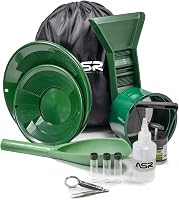
The gold panning equipment guide covers the basic tools and how they fit together. For black sand work, focus on a pan, a classifier, a small container, and a magnet that you can control accurately.
The SE Gold Prospecting-Sifting-Panning is a 13.25 in stackable classifier with a 1/12 in stainless steel mesh. Its 0.08 in mesh openings help screen gravel, rocks, soil, and debris before you pan.
Use a classifier when your feed contains mixed gravel or larger debris. It suits prospectors who want to reduce the size of material before panning, while its stackable design helps when you are sorting several batches.
The mesh opening is part of the choice. A finer screen can remove more small material from the feed, but it can also slow the process if the material is sticky or full of clay.
Which pan works well for magnetic black sand?
A pan with separate riffle patterns helps you control both coarse material and fine concentrate. You want to reduce the amount of material without washing away the fine gold you are trying to inspect.
The SE 14 Inch Gold Panning Pan has dual riffles, including deep 1/4 in riffles and micro riffles. Its 1/8 in base pan is designed to hold material while you work through sediment, sand, rocks, and black sand.
Choose this pan if you want one circular plastic pan with two riffle types for coarse and fine work. The green color can make yellow gold easier to see against the pan, while plastic does not rust or corrode.
Use the deep riffles early in the process, then work more gently as the amount of material falls. The fine concentrate deserves slower movements because a fast wash can carry small particles away.
Hand wash the pan after use. Keep the riffles clear so the next cleanup starts with predictable water flow.
How should you remove magnetic sand without losing gold?
Use a covered magnet and take several small passes instead of stripping the whole concentrate at once. This gives you more control and lets you check the separated material.
Start with a shallow, dry layer on a clean surface. Hold the covered magnet just above the material and move it across one section at a time.
Lift the magnet straight up. Turn it over above a labeled container, slide the covering off, and return the magnetic material there before replacing the cover.
Inspect both containers. Gold can remain mixed with black sand, and fine particles can cling together, so magnetic separation should reduce the work rather than replace visual inspection.
If you prefer to make your own tool, how to make a black sand magnet explains the basic idea. Keep the magnet easy to cover and uncover so you can release the removed material without scattering it.
Can wet black sand be tested with a magnet?
Yes, but dry or partly drained material is usually easier to control. Water can make fine sand move as a group, which may carry nonmagnetic grains along with the magnetic material.
Let excess water drain from the concentrate before testing. If you work wet, use a shallow pan and move the magnet slowly above the surface rather than dragging it through the material.
A covered magnet still helps when the sand is damp. The cover prevents grains from packing around the magnet and makes it easier to release the removed material for inspection.
The method is not a purity test. A strong magnetic response means the sample contains magnetic grains, not that it contains gold or that every black grain is magnetite.
Is dark sand always attracted to a magnet?
No. Dark color does not guarantee magnetic behavior.
Some sand looks black because of its mineral color, while only part of the sample responds to a magnet.
You can compare several small portions instead of testing one large pile. This shows whether the magnetic material is spread evenly or gathered in separate streaks.
Our guide to whether sand is attracted to a magnet explains why ordinary sand can include both magnetic and nonmagnetic grains. The result depends on the minerals in that particular sample.
Avoid using a magnet as the only field test. A sample may contain heavy nonmagnetic minerals that look similar to magnetite and may settle beside fine gold.
What can help manage water during panning?
Water control matters before magnetic cleanup because an oversized or muddy batch is harder to inspect. A hand pump can help remove collected water from a small boat, canoe, kayak, bilge, or another place where water gathers.
The SeaSense Hand Bilge Pump is a self-priming manual pump with a removable 24 in x 36 in hose. It has a plastic construction, an ergonomic handle, and a 1.8 lb listed item weight.
Choose it for water removal rather than for separating black sand. It suits readers who need a hand-operated pump for small boats, kayaks, canoes, bilges, or other places where water collects.
The pump is a separate support tool, so it will not classify gravel, move magnetic minerals, or replace a gold pan. Its role is to help manage water around the activity when a manual pump fits the setting.
Keep the hose and pump clear after use. Store the removable hose with the pump so the setup is ready when collected water becomes a problem.
What is the best way to decide if black sand is magnetic?
Test a small sample first, then use a covered magnet in slow passes after panning has reduced the material. Magnetite and some other iron-rich minerals should move toward the magnet, while gold and many dark minerals stay behind.
Pick the SE classifier if large gravel and debris are slowing your cleanup. Pick the SE 14 in pan if you need dual riffles for working from coarse sediment toward fine black sand.
Choose the SeaSense pump only when water removal is part of your setup. It helps with collected water, but it is not a black sand tool.
The main rule is simple: use a magnet to reduce magnetic concentrate, not to identify gold by itself. Inspect the material left behind and the material removed, then continue panning carefully until the concentrate is small enough to check.
Frequently asked questions
Is all black sand magnetic?
No. Black sand can contain magnetite, which is strongly magnetic, along with ilmenite, garnet, chromite, and other dark minerals that may respond weakly or not at all.
A magnet can separate part of a concentrate, but it cannot identify every black mineral or prove that gold is present.
Does gold stick to a magnet?
No. Pure gold is not attracted to an ordinary magnet.
If black sand sticks to a magnet while yellow flakes remain behind, the magnetic material is more likely to be iron-rich concentrate.
Small gold pieces can still stay mixed with it, so remove magnetic sand in controlled passes.
How do you remove magnetic black sand from gold?
Let the concentrate dry or become easy to control, then move a covered magnet slowly above it. Lift away small amounts of magnetic material, release them into a separate container, and repeat.
Keep the magnet covered so you can return or inspect the separated material.
Can a magnet find gold in sand?
A magnet cannot attract gold directly. It can help reduce magnetic black sand around gold, making fine flakes easier to see during cleanup.
Use it as a separation aid after classifying and panning, not as a gold detector or a substitute for careful inspection.