Which Walk Through Metal Detector Brand Should You Choose?
The best walk through metal detector brand depends on your screening setting, traffic level and installation space. Compare detection zones, sensitivity controls, alarm handling, service support and the room needed for setup before choosing a brand.
On this page (11 sections)
- Which walk through metal detector brands fit different screening needs?
- What type of walk-through detector should you choose?
- How do walk-through detector brands differ by installation?
- Do you need a handheld detector with a walk-through system?
- What sensitivity controls matter most?
- How should a brand handle alarms?
- How do you compare walk through metal detector brands fairly?
- What should you check before installation?
- Can a walk-through detector work outdoors?
- What other metal detector questions should you ask?
- Which walk through metal detector brand should you choose?
The best walk through metal detector brand depends on your screening setting, traffic level and installation space. Compare detection zones, sensitivity controls, alarm handling, service support and the room needed for setup before choosing a brand.
A school entrance, event venue, workplace and public building may all need different screening arrangements. The right choice is not simply the brand with the most sensitivity.
It is the system that staff can operate consistently while keeping the entrance moving.
Walk-through detectors and handheld wands serve different jobs. A walk-through unit screens people as they pass through a defined lane, while a wand supports a closer check after an alarm or when a full portal is not practical.
If you need a product shortlist first, see our guide to the best walk through metal detectors. For secondary screening, our best metal detector wand guide covers handheld options.
Which walk through metal detector brands fit different screening needs?
The best brand for a busy entrance is usually the one with the right detection zones, clear alarm controls and practical installation support. A smaller site may place more weight on simple operation, while a high-traffic venue may need stronger configuration and service planning.
Start by defining the screening job:
| Screening need | What to compare |
|---|---|
| School or workplace entrance | Simple alerts, staff training and controlled foot traffic |
| Event venue | Fast throughput, clear alarms and repeatable procedures |
| Government or public building | Detection zones, policy controls and maintenance support |
| Temporary checkpoint | Transport, setup time, power and storage |
| Secondary inspection | Handheld sensitivity, alarm modes and operator comfort |
| Outdoor or semi-outdoor use | Weather limits, enclosure and placement requirements |
A walk-through unit should create a consistent screening lane. If staff must improvise where people stand, where bags go or how alarms are handled, even a capable detector can produce uneven results.
Ask each brand how its equipment is calibrated, serviced and updated. Also ask who installs the system, what training is available and how quickly replacement parts or technical help can be obtained.
What type of walk-through detector should you choose?
Choose a walk-through detector by how much control you need over the screening lane. Basic systems may suit a controlled entrance, while sites with changing security needs may benefit from adjustable zones and more detailed alarm controls.
Important features include:
- Detection zones that show where metal was found.
- Adjustable sensitivity for different screening policies.
- Audible and visual alarms that staff can recognize.
- Controls that prevent accidental setting changes.
- A stable frame that fits the intended doorway.
- Power and cable arrangements that suit the site.
- Calibration instructions that staff can follow.
- Access for cleaning, inspection and repairs.
A high-sensitivity setting is not automatically better. If the detector alarms constantly on harmless items, staff may begin to treat alarms as routine.
If sensitivity is too low, the system may not match the site's screening policy.
The brand should explain how operators set the system for the location. The entrance may contain nearby metal structures, security furniture or electrical equipment that affect setup.
How do walk-through detector brands differ by installation?
Installation requirements can matter as much as detection performance. Measure the doorway, floor area, power route and surrounding metal before choosing a brand or model.
Check these points before ordering:
- Measure the available width and height.
- Confirm the detector will leave room for a controlled entry and exit.
- Check the floor for level support and trip hazards.
- Plan where the power cable will run.
- Keep the operator's position visible to the entrance.
- Leave access for calibration and maintenance.
- Check the operating environment, including moisture and temperature.
- Confirm that nearby doors, rails or furniture will not interfere.
A walk-through detector needs a predictable lane. If people can bypass the frame, gather beside it or enter from several directions, the screening process becomes harder to manage.
Temporary installations need a different plan from permanent entrances. A venue that changes rooms or locations may value simpler assembly and transport, while a fixed public entrance may benefit from a more permanent installation and service arrangement.
The brand's instructions should also explain startup checks and alarm testing. These checks help staff confirm that the system is ready before the entrance opens.
Do you need a handheld detector with a walk-through system?
A handheld detector can support a walk-through system by helping staff locate the source of an alarm. It can also suit small sites that cannot install a portal, but it requires an operator to scan each person consistently.
Use a handheld unit for secondary screening when:
- A person triggers a walk-through alarm.
- Staff need to check a specific area more closely.
- The entrance is too small for a portal.
- Screening is temporary.
- A parcel or letter needs a metal check.
- A quiet vibration alert is useful.
Handheld screening has limits. The operator must maintain a consistent scan pattern, keep the device close enough to the inspection area and follow the site's privacy and safety procedures.
DR.ÖTEK Metal Detector Pinpointer
The DR.ÖTEK Metal Detector Pinpointer suits close target location after a metal signal, especially when the user wants a small handheld detector with visual, audio and vibration alerts. Its LCD screen, LED light, 360° side-scan function and one-touch signal cancellation give the operator several ways to locate a target.
This is a pinpointer for locating coins, jewelry and other metal objects across sand, grass, soil or around a home and garden. It is not a walk-through security portal, so it fits a different part of the screening process.
The IP68 rating supports use underwater in lakes, rivers, oceans or wet sand. The red unit uses battery power and has a 7 KHz operating frequency.
The package includes the MT6 PRO pinpointer, retractable hanging wire, belt loop, user manual and 9V battery. Its anti-slip rubber grip and 5.92 oz weight may help when the operator needs to hold it for repeated close checks.
Choose it when the job is precise target location in wet or outdoor conditions. Choose a security wand or walk-through system when the task is screening people at an entrance.
Garrett Super Scanner V Handheld Security Metal
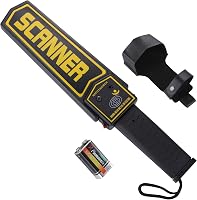
The Garrett Super Scanner V Handheld Security Metal suits security screening that needs an 8 in scan surface, self-calibrating operation and audible or silent vibration alerts. Its 17 in length, LED display and all-metal detection are aimed at handheld inspection rather than portal screening.
Garrett Metal Detectors describes it as a professional-grade security wand that detects ferrous, non-ferrous and stainless-steel metals. The controls include a momentary push button to reduce interference from ambient metals.
The black wand has an ABS plastic case, a weatherproof rubber handle and an IP54 rating. It is battery powered and weighs 1.1 lb.
The stated detection examples include a medium-sized pistol at 9 in, a large knife at 6 in, razor blades and box cutters at 3 in, and foil-wrapped drugs and tiny jewelry at 1 in. These distances are product claims, so the actual result can depend on the target, scan path and surrounding conditions.
Choose it when secondary screening needs a large scan surface and flexible alarm modes. A walk-through detector remains the better fit for screening a steady flow of people through a defined lane.
RANSENERS Handheld Metal Detector Wand
The RANSENERS Handheld Metal Detector Wand suits security checks that need sound or vibration alerts, adjustable sensitivity and a portable 16.14 in body. Its low-sensitivity switch can help an operator focus on larger metal objects instead of responding to smaller items such as rings, keys, coins or pins.
The wand is designed for indoor and outdoor events, including airports, schools, train stations, subways, docks, sports events and exhibition centers. It can also be used to check parcels and letters for metal objects.
The black plastic unit weighs 12 oz and has an IP54 rating. It uses a 7.69 KHz operating frequency and includes a holster clip, battery and English user manual.
The unit can use one standard 9V battery or a rechargeable battery. The rechargeable battery is not included, and the charger is not included.
If a rechargeable battery is used, follow the power instructions and turn the detector off when charging.
Choose it when portability, adjustable sensitivity and quiet vibration alerts matter. Choose a walk-through system when you need a fixed lane that screens people as they enter.
What sensitivity controls matter most?
Sensitivity controls should match the site's screening policy, not simply be set as high as possible. The useful setting is the one that detects the objects the policy covers while keeping unnecessary alarms manageable.
Look for:
- Multiple detection zones.
- Separate sensitivity levels.
- A clear way to change settings.
- An interference control or calibration process.
- Audible and visual alarm choices.
- A record of the settings used at the entrance.
A fixed sensitivity setting may be simple for a small site, but it can be less flexible when the entrance changes. Adjustable settings can help, but they also create more responsibility for staff training and daily checks.
Handheld products show the same trade-off. The Garrett Super Scanner V uses self-calibrating technology, while the RANSENERS wand has an adjustable sensitivity switch.
The DR.ÖTEK pinpointer uses one-touch signal cancellation to reduce false signals in complex environments.
Do not compare these controls as if they were identical. A pinpointer's signal cancellation helps locate outdoor metal targets, while a security wand's sensitivity setting supports a screening procedure.
How should a brand handle alarms?
A detector brand should make alarm handling clear enough that every operator follows the same process. An alarm should trigger a defined next step, not an improvised decision.
A basic procedure may include:
- Ask the person to step aside from the main entrance.
- Keep the screening lane moving when possible.
- Use a handheld wand for a closer check.
- Scan in a consistent pattern.
- Follow the site's rules for prohibited items.
- Record equipment faults or repeated false alarms.
- Escalate unusual situations to the responsible supervisor.
The exact process depends on the building and its policy. The detector itself cannot replace staff judgment, visitor communication or emergency procedures.
Choose a brand that provides usable controls and clear operating instructions. If staff cannot tell which alarm mode is active or how to adjust the system, the equipment may be difficult to use consistently.
How do you compare walk through metal detector brands fairly?
Compare brands using the same questions and the same site conditions. A fair comparison weighs detection needs, installation work, operator training and long-term support together.
Use this checklist:
| Question | Why it matters |
|---|---|
| What kind of entrance will it screen? | Determines traffic and lane design |
| How many people pass through? | Helps define throughput needs |
| Are detection zones required? | Supports closer alarm location |
| Who will operate the system? | Affects controls and training |
| Is the site permanent or temporary? | Changes installation priorities |
| Is power available nearby? | Affects placement and cable planning |
| Is the area dry and enclosed? | Determines environmental suitability |
| How will calibration be checked? | Supports consistent operation |
| Who provides service? | Reduces downtime risk |
| Are replacement parts available? | Helps with long-term maintenance |
| Can staff use a handheld wand too? | Supports secondary screening |
Do not compare a walk-through frame with a handheld wand as direct substitutes. They can work together, but they solve different parts of the screening job.
Also separate brand reputation from model fit. A well-known brand may offer useful support, but the exact model still needs to match the doorway, traffic, controls and environment.
What should you check before installation?
Check the space, power and operating process before delivery. The detector should fit the entrance without blocking evacuation routes, doors, accessibility paths or staff visibility.
Create a simple installation plan with:
- The frame location.
- The direction of normal traffic.
- The operator's position.
- The power source.
- The cable path.
- The area for secondary screening.
- The maintenance access.
- The location for instructions and records.
Keep the secondary screening area close enough to the entrance for practical use, but far enough away that it does not block people passing through. A handheld wand can be stored in a predictable place so operators do not search for it during an alarm.
If the installation is temporary, label components and record the normal settings. This helps the next operator rebuild the arrangement consistently.
Before opening the entrance, carry out the brand's startup and calibration steps. Check that visual and audible alarms work, that staff understand the controls and that the screening lane is easy to follow.
Can a walk-through detector work outdoors?
Outdoor use depends on the exact system and its installation conditions. Do not assume that a weather-resistant handheld wand makes a complete walk-through setup suitable for outdoor use.
Check the enclosure, power protection, floor stability, moisture exposure and temperature limits. Rain, condensation, direct sunlight and uneven ground can affect equipment and operator safety.
The handheld products here show why ratings need careful reading. The Garrett Super Scanner V and RANSENERS wand have IP54 ratings, while the DR.ÖTEK pinpointer has an IP68 rating and is described for full submersion.
Those ratings apply to the individual products, not to a complete screening station. The frame, power supply, cables and surrounding setup still need separate consideration.
For outdoor events, protect the equipment from weather while keeping the screening lane visible and accessible. Confirm the brand's instructions before using a walk-through unit in an open or damp location.
What other metal detector questions should you ask?
Your screening policy should decide the detector type. If you are comparing what ordinary hobby detectors can find rather than planning entrance security, our guide to What Can You Find With a Metal Detector? covers coins, jewelry, relics and other targets.
If your question is about detection through a building material, read Can a Metal Detector Detect Through Wood?. The answer depends on the metal target, the detector type and the material between the sensor and target.
You may also see well-known hobby detector brands discussed in treasure hunting content. For example, our guide on what metal detector Gary Drayton uses addresses a different use case from entrance screening.
For security equipment, ask these questions:
- Does the system screen the full body height?
- Can staff identify the alarm area?
- How are sensitivity settings protected?
- What happens if the unit loses power?
- How often should operators check calibration?
- Is a handheld wand part of the procedure?
- Who handles service and repairs?
- Does the installation fit accessibility and evacuation needs?
These questions help separate a hobby detector, a handheld security wand and a walk-through portal. The brand should be judged against the job you need it to perform.
Which walk through metal detector brand should you choose?
Choose the brand that fits your traffic, entrance layout, screening policy and support needs. A walk-through system suits a defined screening lane, while a handheld wand adds a closer secondary check.
For secondary screening, the Garrett Super Scanner V suits operators who want an 8 in scan surface, self-calibrating operation and audible or vibration alerts. The RANSENERS wand suits portable checks with adjustable sensitivity, sound or vibration modes and a belt holster.
The DR.ÖTEK pinpointer is a different tool for close target location. Its IP68 waterproof design, LCD screen, LED light and 360° side-scan function make it more suitable for outdoor or underwater metal locating than entrance security.
Before choosing among walk through metal detector brands, measure the site, define the alarm process and confirm service support. Then select the system that staff can set up, operate and maintain consistently.
Frequently asked questions
Which walk through metal detector brand is best?
The best walk through metal detector brand is the one that matches your traffic, screening policy, site space and service needs. Compare detection zones, alarm controls, sensitivity adjustment, installation requirements and support before choosing.
A handheld wand can support secondary checks, but it does not replace a walk-through system.
What should I compare between walk through metal detector brands?
Compare detection zones, sensitivity settings, alarm types, power needs, installation space, calibration controls, weather limits and service support. Also check whether the system suits your screening policy and expected traffic.
A low-cost unit may not fit a busy entrance if setup, calibration or access to support is limited.
Can a handheld wand replace a walk through metal detector?
A handheld wand usually works best as a secondary screening tool, not as a replacement for a walk-through detector. It can help an operator check a person or item after an alarm, while a walk-through system screens each person through a defined doorway or lane.
Do walk through metal detectors need professional installation?
Some walk-through systems need careful assembly, calibration and placement, while others are designed for simpler setup. Confirm the unit's power, floor space, doorway clearance, operating environment and calibration process before buying.
Busy sites should also plan for staff training and maintenance access.
Are all walk through metal detector brands suitable for outdoor use?
No. Outdoor suitability depends on the detector's enclosure, weather protection, operating limits and installation method.
Check the exact model before placing it outside or in an open-sided area.
A handheld detector with an IP rating still does not prove that a complete walk-through setup is suitable for outdoor use.