Fisher F44 Metal Detector Review: Worth It? (November 2026)
The Fisher F44 suits everyday detecting if you want a weatherproof, battery-powered detector with a large LCD display, adjustable discrimination and depth information. Choose a pinpointer as a companion when you need faster target recovery.
On this page (11 sections)
- Is the Fisher F44 a good everyday metal detector?
- Fisher F44 features that matter in daily use
- Fisher F44 weatherproof design and water limits
- How the Fisher F44 display and settings help
- Fisher F44 setup for a first hunt
- F44 versus F22 for adjustable detecting
- Do you need a pinpointer with the Fisher F44?
- Which products fit an F44 setup?
- What can you find with the Fisher F44?
- Fisher F44 care and storage
- Fisher F44 metal detector review verdict
The Fisher F44 is a strong choice for adjustable everyday detecting when you want a weatherproof detector with a large LCD display, sensitive detection features and battery power. Its main limit is that weatherproof does not mean fully submersible.
The F44 makes sense for park, beach and field searches where you want more control than a very basic detector provides. A pinpointer can make the recovery stage easier, but it does not replace the F44's wider search coil.
Our score weighs specs, features and buyer feedback against the needs of someone shopping for an adjustable everyday detector.
Is the Fisher F44 a good everyday metal detector?
Yes, the Fisher F44 fits everyday detecting because it combines an 11 in search coil, 5 programs, adjustable discrimination, target depth indicators and a large LCD display. It is battery powered and has an average battery life of 30 hours.
The weatherproof design adds flexibility for outdoor use, but you should still separate light weather protection from underwater use. If water recovery is your main goal, choose a tool designed for submersion.
For a wider look at the brand's range, compare these best Fisher metal detectors before deciding which level of control fits your plans.
Fisher F44 metal detector review: who should buy it?
The Fisher F44 suits beginners who want adjustable settings and experienced detectorists who need a practical detector for regular outdoor searches. The large LCD display can make target information easier to read while you move between locations.
It is less suitable if you need a fully waterproof detector for underwater hunting. In that case, a submersible pinpointer may help with recovery, but you should choose your main detector based on its own water-use limits.
Fisher F44 features that matter in daily use
The F44's useful advantage is control without a complicated setup. Its adjustable discrimination can help you respond differently to unwanted metals, while target depth indicators give you an estimate to consider before digging.
The 5 programs give you different starting points for a hunt. You can begin with a suitable program, then adjust sensitivity or discrimination as the ground and targets change.
The large LCD display is useful when you want to read target information without stopping to interpret a small screen. Audio feedback adds another way to respond to a target, especially when you are watching the ground.
Sensitive detection features may help locate small or deeper buried metal, but sensitivity is not a promise that every target will be found in every soil type. Start with a stable setting and adjust only when the detector remains quiet enough to interpret.
The 11 in search coil covers a useful area as you sweep. Keep each pass close to the previous one so you do not leave gaps between sweeps.
Fisher F44 weatherproof design and water limits
The Fisher F44 has a weatherproof design and IP54 rating, which supports outdoor use in changing conditions. That does not make it a 20 ft underwater detector or a fully waterproof pinpointer.
Use reasonable care around rain, wet grass and damp ground. Keep water away from openings and controls as much as possible, and dry the detector after a wet hunt before storing it.
The word weatherproof should guide your expectations. If your detecting plans include rivers, shallow water or underwater recovery, compare the F44 with a purpose-built waterproof companion.
The Garrett Pro-Pointer AT is not the focus of that comparison page, so use the product section below for its stated water capability. The important buying question is whether you need weather resistance for normal outdoor hunts or submersion for recovery work.
How the Fisher F44 display and settings help
The large LCD display gives you target information in an easy-to-read format. That can help when you are learning how target responses relate to what you uncover.
Start by learning one program at a time. Use the same search area for practice, sweep at a steady pace and note how known objects respond before changing several controls together.
Adjustable discrimination can help you decide which signals deserve attention. It should not be treated as a guarantee that unwanted metal will disappear or that every valuable target will sound the same.
Target depth indicators can help you judge whether a signal may be shallow or deeper. Treat the depth reading as a guide, then use careful recovery methods that protect the ground and the target.
The F44's audio feedback also matters when the display is not your only focus. Listen for repeatable responses from different sweep directions, then decide whether the signal is worth digging.
Fisher F44 setup for a first hunt
Set up the F44 with the search coil secure and the controls easy to reach. Confirm the battery is ready before leaving, especially because the detector is designed for outdoor use away from a power outlet.
Choose a clear practice area and sweep slowly. Keep the coil at a consistent height above the ground, and overlap each pass so your search pattern stays organized.
Begin with a stable program and moderate adjustments. If the detector becomes noisy, reduce unnecessary changes and return to a setting you can understand.
When you receive a repeatable signal, approach it from another direction. A consistent response from more than one angle is more useful than a single quick sound.
Use the target depth indicator as one clue, not the whole decision. Dig carefully, keep the plug together and replace the soil when you finish.
For basic control practice with another Fisher detector, see how to use a Fisher F2 metal detector. The operating controls differ, but the habits of steady sweeping and careful recovery still apply.
F44 versus F22 for adjustable detecting
The F44 is the better fit when you want its larger 11 in search coil, 5 programs and stated adjustable features. Choose the F22 when its simpler feature set and lower learning curve better match your search plans.
A detector should fit the way you expect to hunt. If you want to learn more controls and change settings as conditions shift, the F44 gives you more listed adjustment points to work with.
If you want a simpler start, compare the Fisher F22 metal detector review for a closer look at that model. The Fisher F22 vs F44 comparison can also help if both are on your shortlist.
The F44 is not automatically better for every buyer. More controls are useful only when you plan to learn what they do and use them during your hunts.
Do you need a pinpointer with the Fisher F44?
A pinpointer is useful when the F44 has already located a target and you need to narrow the recovery spot. It can reduce the time spent checking loose soil, the hole and the removed plug.
The Minelab PRO-FIND 35 adds tone ID, 5 sensitivity levels, audio and vibration indication, a built-in flashlight, a holster and a lanyard. Its waterproof rating reaches 10 ft, so it suits wet soil, beaches and riverbanks within that limit.
The Garrett Pro-Pointer AT is submersible to 20 ft and has 3 sensitivity levels. Its orange color can improve visibility around water, while its one-button control keeps power and adjustments simple.
A pinpointer does not search the same broad area as the F44's 11 in coil. Use the main detector to find the signal, then use the pinpointer to narrow the target location.
Which products fit an F44 setup?
The Fisher F44 remains the main choice for wide-area everyday detecting in this group. It has a weatherproof design, LCD display, sensitive detection features, 5 programs and battery power.
Fisher F44 Metal Detector with Weatherproof Design: Best for adjustable everyday detecting
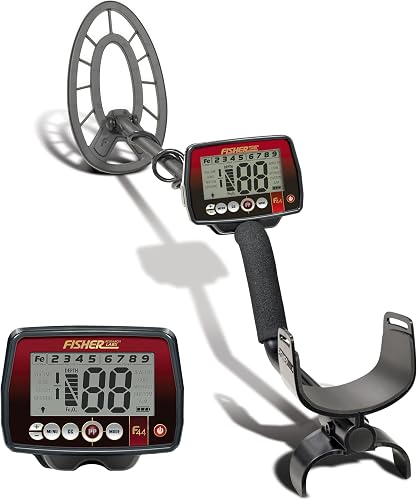
- Weatherproof design
- Large LCD display
- Sensitive detection features
- 5 programs
- 11 in search coil
- Battery powered
A practical choice for beginners and experienced detectorists who want adjustable features, a large display and outdoor flexibility.
Pros
- Weatherproof design
- Large LCD display
- Adjustable discrimination
- Target depth indicators
- 30 hours average battery life
Cons
- Weatherproof is not the same as fully submersible
- Battery replacement is part of regular preparation
The title describes the F44's role clearly: a weatherproof detector with a large LCD display and sensitive detection features. Its 30-hour average battery life supports longer outings, while the 22 in extended length and 3.6 lb weight are useful details to consider before carrying it on a full-day hunt.
Choose the F44 if you want a full-size detector with adjustable discrimination, depth indicators and audio feedback. The main trade-off is water protection.
Weatherproof outdoor use is different from submersion, so match the detector to your search environment.
The Minelab PRO-FIND 35 is a focused recovery tool rather than a replacement for the F44. Its ferrous tone ID can add another response when you are deciding where to check next.
Minelab PRO-FIND 35 Waterproof Pinpointer Metal Detector: Best for tone-based pinpointing

- Waterproof to 10 ft
- Tone ID
- 5 sensitivity levels
- Built-in flashlight
- Holster and lanyard included
A companion tool for detectorists who want ferrous tone ID, adjustable sensitivity and audio plus vibration feedback during recovery.
Pros
- Tone ID helps separate ferrous and nonferrous targets
- 5 sensitivity levels
- Waterproof to 10 ft
- Built-in flashlight
Cons
- It is a pinpointer, not a replacement for a full-size search coil
- Its expert-focused feature set may be more than a beginner needs
The Garrett Pro-Pointer AT is the better match when deep water recovery is central to your routine. Its 20 ft submersion rating exceeds the Minelab's 10 ft rating, while the orange casing can make it easier to spot in water.
Garrett Pro-Pointer AT Waterproof Metal Detector: Best for deep water recovery

- Submersible to 20 ft
- 3 sensitivity levels
- One-button control
- Orange visibility
- Built-in ruler and lanyard loop
A waterproof pinpointer for beach, river and underwater recovery where visibility and deeper submersion matter.
Pros
- Submersible to 20 ft
- Orange color is easier to see underwater
- 3 sensitivity settings
- One-button adjustment
Cons
- Shorter stated battery life than the F44
- Pinpointing tool rather than a primary detector
What can you find with the Fisher F44?
The F44 is designed for metal detection, including searches for coins, relics, jewelry and other buried metal objects. The detector's sensitive features can help you investigate small or deeper targets, but the result depends on the ground, target and settings.
Use local rules before detecting on public land, beaches or historical sites. Respect private property, fill every hole and avoid disturbing protected areas.
Your goal also affects the best settings. Coin hunting may call for a different balance of discrimination and sensitivity than relic hunting or general practice.
For ideas about realistic targets and search locations, read What Can You Find With a Metal Detector?. The broader guide [What Is a Metal Detector Used For?
The Basics](/what-is-a-metal-detector-used-for/) explains how detectors fit different search tasks.
Fisher F44 care and storage
Store the F44 clean, dry and ready for the next battery-powered hunt. Wipe away dirt after use, dry the detector after damp conditions and check the coil and cable before packing it away.
Remove or replace batteries according to the manufacturer's instructions if the detector will sit unused for a long period. Carry spare batteries when you plan a long trip because the average battery life is 30 hours, not a fixed guarantee for every hunt.
Keep the LCD and controls free from mud and grit. Avoid forcing dirt into seams or using more water than the detector's weather protection allows.
Check the search coil before each outing. A loose connection or damaged cable can make a normal target response harder to interpret.
Fisher F44 metal detector review verdict
The Fisher F44 is the best fit for adjustable everyday detecting when you want a weatherproof design, a large LCD display, 5 programs, an 11 in search coil and battery power. Its controls give beginners room to learn and experienced users room to adjust.
Pick the F44 for parks, beaches and fields where outdoor weather protection is useful. Add the Minelab PRO-FIND 35 for tone ID and 10 ft waterproof recovery, or choose the Garrett Pro-Pointer AT when 20 ft submersion matters most.
If you are still comparing Fisher models, start with the Fisher F75 metal detector review to see whether a different feature set better matches your detecting plans.
Frequently asked questions
Is the Fisher F44 weatherproof?
The Fisher F44 has a weatherproof design and an IP54 rating, so it suits outdoor detecting in changing conditions. Weatherproof does not mean fully submersible, so keep the detector within the use limits described by Fisher and avoid treating it like an underwater pinpointer.
Is the Fisher F44 good for beginners?
The Fisher F44 can suit beginners who want room to learn adjustable detection settings. Its large LCD display, 5 programs, target depth indicators, audio feedback and adjustable discrimination give you useful controls without requiring a separate screen or accessory.
How long does the Fisher F44 battery last?
The Fisher F44 has an average battery life of 30 hours. Carry suitable spare batteries for longer trips, and check the detector before leaving because battery life can vary with settings, temperature and how often you use the controls.
What is the difference between a detector and a pinpointer?
A full-size detector searches a wider area with its search coil, while a pinpointer helps narrow the target location after you dig. The Fisher F44 is the primary detector here, while the Garrett Pro-Pointer AT and Minelab PRO-FIND 35 are recovery companions.