9 Best Magnifiers for Coin Grading (November 2026)
The best magnifiers for coin grading include the Elikliv Microscope for detailed coin grading, the Elikliv Coin Microscope with Weighing Scale for grading plus weighing, and the TOMLOV DM4W Microscope with Weighing Scale for stable weighing and viewing.
On this page (9 sections)
- How we compared magnifiers for coin grading
- The best magnifiers for coin grading in detail
- Compare the top magnifiers side by side
- How do you choose magnification for coin grading?
- Loupe, digital microscope or hands-free magnifier: which fits you?
- Do you need a scale built in?
- How does lighting change what you see when grading?
- How do you set up and care for a magnifier for grading?
- Verdict: which magnifier should you buy for coin grading?
The best magnifier for coin grading is the Elikliv Microscope, because its 4.3 inch screen, 8 adjustable LED lights and height-adjustable stand make it easy to check dates, minting symbols and condition without holding a loupe to your eye.
This guide covers the best magnifier for coin grading for different budgets and work styles, from digital microscopes with screens and scales to classic loupes and hands-free viewers.
Grading is about surfaces, wear and small defects.
You need enough power to see a mint mark clearly, enough light to judge relief without glare, and a steady view that does not tire your eyes.
A coin magnifier that suits one collector may suit another poorly, so match the tool to how you grade.
Our score weighs specs, features and buyer feedback against what you're shopping for.
We compared magnification, screen size, lighting, portability and extra tools such as scales and cameras.
We did not test these products, and maker claims are labeled as such below.
Use our coin magnifier buying guide for the full breakdown of types, and our guides to the best jewelers loupe to buy and the best magnifier for coin collecting if you want to compare loupe styles before you decide.
Our picks at a glance
-
1

-
2
 Best for grading plus weighing
Elikliv Coin Microscope with Weighing Scale
9.5/10 our score
See it on Amazon -
3
 Best for stable weighing and viewing
TOMLOV DM4W Microscope with Weighing Scale
9.4/10 our score
See it on Amazon
- 4
 Check it
Amoper 30X Loupe Magnifier Loop Magnifying Glass
Best for high power handheld checks - 5
 Check it
VisionAid 30X 10X Hands-Free Magnifying Glass with
Best for hands-free reading style grading - 6
 Check it
TOMLOV P10 Microscope for Adults Kids
Best for portable quick checks - 7
 Check it
Vision Aid 30X 10X Hands-Free Magnifying Glass with
Best for long comfortable sessions - 8
 Check it
DANOPLUS 10x Magnifier Jewelry Loupe LED UV
Best for a classic pocket loupe - 9
 Check it
Leipan 4.3" Coin Microscope Coin Magnifier
Best for photo and video records
How we compared magnifiers for coin grading
We checked each model against the work of grading: seeing wear on high points, reading dates and mint marks, spotting small defects, and judging luster and glare.
We looked at magnification range, lens or screen size, lighting control, stand stability and whether the tool records photos or weight.
Digital microscopes won on comfort and sharing.
Loupes won on speed and portability.
Hands-free magnifiers won on field of view and long sessions.
Scales helped where weight is part of the check, and cameras helped where a record matters.
What grading actually requires
Grading starts with overall wear, then moves to smaller features such as mint marks and edge details.
A tool that only shows a tiny high power field can miss broad wear patterns.
A tool with only low power can miss the defects that change value.
That is why the comparison below balances field of view against maximum magnification instead of ranking by power alone.
Screen size and viewing angle also matter for posture.
A 4.3 inch screen lets you sit back and keep both hands free to rotate a coin.
A small loupe forces a closer head position, which is fast for a single check but tiring over an hour.
Lighting is the third factor, because a bright direct light can hide scratches on reflective surfaces.
Models with adjustable or side lighting give you more control over contrast and glare.
Portability and power source decide where you can work.
Loupe batteries, rechargeable packs and USB power each suit different settings.
We factored those daily use details into each product write up, rather than listing headline magnification in isolation.
The best magnifiers for coin grading in detail
Elikliv Microscope: Best for detailed coin grading
- LCD Digital Coin Microscope 1000x
- 4.3 inch display
- 8 adjustable LED lights
- Height-adjustable stand
- PC view compatible with Windows
A digital microscope built for close checks of dates, minting symbols and overall condition, with a screen that reduces eye strain during long grading sessions.
Pros
- 4.3 inch screen for shared viewing
- 8 adjustable LED lights
- Height-adjustable stand
- PC view for larger display
Cons
- Memory card not included for saving photos or video
- Best for close detail rather than whole coin at low magnification
Elikliv suits collectors who grade at a desk and want a screen instead of a loupe at the eye.
Its 4.3 inch display shows live images while you sit back, and 8 adjustable LED lights help in low light rooms.
Height adjustment changes camera-to-object distance, so you can trade field of view for magnification as you move across a coin.
Elikliv says the microscope connects to Windows or MacBook for a larger view, and photos and video can be stored with your own memory card.
That makes it useful for documenting a date or mint mark before you clean or store a coin.
The built-in rechargeable battery gives up to 3 hours of continuous use, according to Elikliv.
The 720P imaging and multi coated lens help keep edges readable when you zoom to check lettering.
At 1.1 pounds, the unit is light enough to move between a desk and a collection cabinet.
The trade-off is that this is a close-up tool.
Elikliv says flipping the camera and raising it shows more of the coin at lower magnification, but the standard setup is for detail.
If you mainly need a whole-coin view, a large hands-free magnifier may serve you better.
Elikliv Coin Microscope with Weighing Scale: Best for grading plus weighing
- Digital magnifier with 8+2 lights
- 4.3 inch IPS screen
- 0.1g precision weighing scale to 300g
- 12MP camera and 1080P video
- USB PC view
Combines magnified inspection with a built-in scale in grams, ounces and carats, so you can check surface details and weight without switching tools.
Pros
- Built-in 0.1g scale to 300g
- 10 LED lights for glare control
- 4.3 inch IPS screen
- Photo and video capture
Cons
- Micro SD card not included
- Optimized for close detail, not full coin view
This Elikliv model suits collectors who want to inspect and weigh in one place.
Its 0.1g precision scale to 300g covers coins, jewelry and gold in grams, ounces or carats. For a primer on 14K gold composition, see this guide.
Elikliv says readings settle in 0.1 seconds on a stable metal base, which helps when you sort many coins in a row.
The 12MP camera and 1080P video give you a clearer record than the 720P class models for listings and archives.
The 4.3 inch IPS screen has a 178 degree viewing angle, so you can sit at a normal angle and still read dates and mint marks.
Ten LED lights, 8 around the lens plus 2 side lights, help cut glare on proof coins.
USB connection to Windows or Mac gives a larger live view for teaching or sharing.
The handheld design also lets you detach the unit from the stand for outdoor checks of leaves, rocks and other small items.
The trade-off is focus: this model is optimized for close detail and mint marks, not for viewing a whole coin at once.
It also needs a Micro SD card, which is not included, if you want to save files.
TOMLOV DM4W Microscope with Weighing Scale: Best for stable weighing and viewing
- 4.3 inch digital coin magnifier
- Built-in precision scale in g, oz and ct
- 10X to 200X zoom
- 8 inch tall stand
- USB output to macOS or Windows
Pairs a 4.3 inch IPS display with a weighing base and taller stand, giving more room to position a coin while you inspect date, mint mark and edge.
Pros
- Weigh and view in one setup
- 8 inch tall stand
- 4.3 inch IPS display
- USB output for larger screens
Cons
- Scale accuracy depends on stable surface and tare
- Zoom range is lower than some 1000x models
TOMLOV DM4W suits collectors who grade and weigh often and want more working room.
Its 8 inch tall stand and enlarged base give space to place tools and adjust a coin without knocking the microscope.
The built-in scale supports grams, ounces and carats with 0.1g resolution.
TOMLOV says accuracy is plus or minus 0.5g, and the guide notes that a flat stable surface and tare improve results.
The 4.3 inch IPS display has 500 cd per square meter brightness and a 178 degree viewing angle.
Zoom runs from 10X to 200X, which covers date checks through fine defects without jumping straight to extreme power.
The achromatic lens helps reduce color fringing when you compare metal tones and surface marks.
USB output to macOS or Windows gives a larger screen for classroom or club use.
The cord free battery design also supports field inspections and mobile grading at shows.
The trade-off against the Elikliv toppers is maximum zoom and camera specs, which are more modest here.
If scale integration and stand height matter most, this is a strong fit.
Amoper 30X Loupe Magnifier Loop Magnifying Glass: Best for high power handheld checks
- 30X loupe magnifier
- 0.98 inch lens diameter
- 3 white lights and 3 UV lights
- Scaled base
- Soft leather case
A compact 30x loupe for spotting small text, cracks and textures on coins and stamps, with white and UV light modes in a small looping body.
Pros
- 30x magnification in a small body
- White and UV light modes
- Scaled base to measure items
- Protective case included
Cons
- Small 0.98 inch lens shows a small field
- Batteries not provided
Amoper suits collectors who want high power in a small handheld loupe.
Its 30x magnification with a 0.98 inch lens shows small text, cracks and textures that a 10x loupe may miss.
The fixed focal length means you place the object in the middle of the scaled base and move it until the image is clear.
Three white lights help for normal viewing and three UV lights help for checking currency and some surface features.
Amoper says the lights turn off after 10 minutes to save power.
The scaled base has 1/16 inch and 0.5mm scales, which can help you measure a defect or compare sizes.
The zinc alloy body and optical glass lens give a solid feel at 5.76 ounces.
The soft artificial leather case protects the lens during travel to a show or shop.
The trade-off is the small lens: at 30x you see a small area at a time, so this is a spot-check tool rather than a whole-coin grader.
Batteries are not provided, so plan for that cost, and note the four LR936 cells are replaceable under the top screws.
VisionAid 30X 10X Hands-Free Magnifying Glass with: Best for hands-free reading style grading
- 30X and 10X magnification
- Hands-free stand
- LED lights
- 4 inch large lens
- Handheld mode when folded
A large-lens hands-free magnifier that lets you keep both hands free while you turn a coin or work over a page, with LED light for low light rooms.
Pros
- Large 4 inch viewing area
- Hands-free folding stand
- 10X and 30X options
- LED lighting
Cons
- Acrylic lens rather than optical glass
- Less suited to very fine coin defects than a microscope
VisionAid suits grading sessions where holding a magnifier causes hand fatigue.
Its folding stand holds the lens in place so both hands stay free to turn a coin or open a holder.
The large 4 inch lens shows more at once than a small loupe, which helps you scan wear across a surface.
At 9 inches long and 0.28 kg, the unit is still portable enough for a desk or bedside table.
It offers 30X and 10X magnification, so you can start wide for overall condition and move closer for a date or mint mark.
LED lighting helps in low light rooms and reduces eye strain during longer checks.
Folding the stand away turns it into a compact handheld for quick use.
That switch between parked and handheld modes covers both reading and spot checks without a second tool.
The trade-off is optical: the acrylic lens and reading-style design are not made for the finest coin defects.
VisionAid positions this for reading fine print and low vision use.
Choose it for comfort and field of view, and pair it with a loupe or microscope for error checks.
TOMLOV P10 Microscope for Adults Kids: Best for portable quick checks
- Handheld coin magnifier with light
- 2 inch LCD screen
- Fixed 100x magnification
- 16MP camera
- USB PC connection
A light handheld microscope for quick close-up checks away from a desk, with a small screen and fixed focus that makes setup simple for beginners.
Pros
- Lightweight at 3.9 oz
- 2 inch screen for live viewing
- Simple fixed 100x setup
- PC connection for larger view
Cons
- Fixed focus limits flexibility
- Small screen for long grading sessions
TOMLOV P10 suits quick checks at home, at a show or outdoors.
It weighs 3.9 oz and has a 2 inch LCD screen for live viewing without a computer.
Fixed 100x magnification and a working distance of about 0.3 inch keep setup simple: power on, place it near the object, and view the image.
A 16MP camera and built-in memory for 300 photos help you record a flaw or error for later comparison.
The 178 degree viewing angle helps when you share the screen with another person.
USB connection to Windows or Mac gives a larger view when you want to share or edit images.
Dimmable white lights and UV lights give you options for different surfaces.
With up to 50 minutes of use, this is built for short sessions rather than all day grading.
The plastic body and small size make it easy to slip into a bag for field work.
The trade-off is fixed focus.
TOMLOV notes this microscope shows detail in a small area and is not for reading books or fast-moving samples.
It works best for flat, stationary coins and small defects.
If you need adjustable focus or a large screen, look at the desktop microscopes above.
Vision Aid 30X 10X Hands-Free Magnifying Glass with: Best for long comfortable sessions
- 30X and 10X hands-free magnifying glass
- USB rechargeable LED light
- 3 brightness settings
- Foldable stand
- Hard-shell storage case
A rechargeable hands-free magnifier with three brightness settings and a storage case, built for longer sessions where steady light and a stable stand matter.
Pros
- USB rechargeable, no disposable batteries
- 3 brightness settings
- Foldable hands-free stand
- Protective storage case
Cons
- Designed mainly for reading and general close work
- Not a digital microscope for photos
Vision Aid suits long, comfortable grading or reading sessions.
Its USB rechargeable LED light removes the need for disposable batteries, and three brightness settings let you match light to a shiny or dull surface.
The foldable stand holds the magnifier hands-free on a flat surface.
With 30X and 10X magnification, you can move from a broad scan to a closer look at a date or legend.
The acrylic lens at 6.4 ounces keeps the unit light for extended holding.
A hard-shell storage case keeps the lens scratch-free at home or while traveling.
Vision Aid describes distortion-free magnification for small parts and precision tasks.
That clarity helps when you inspect needlework, jewelry repair or model parts as well as coins.
The rechargeable design also means you can work away from an outlet once the unit is charged.
The trade-off is that this is a general close-work magnifier, not a digital microscope.
It does not take photos, weigh coins or connect to a computer.
Choose it for steady light, comfort and storage, and add a loupe or microscope when you need a recorded or higher-power view.
DANOPLUS 10x Magnifier Jewelry Loupe LED UV: Best for a classic pocket loupe
- 10x triplet lens
- 21mm lens diameter
- LED and UV light
- Aluminum body
- Protective case, cleaning cloth and lanyard
A classic 10x triplet loupe in a metal body for grading in hand, with LED and UV light and a pocket size that suits shows and quick checks.
Pros
- 10x triplet lens for clarity
- Pocket size and foldaway design
- LED and UV light
- Kit includes case, cloth and lanyard
Cons
- 10x only, no digital screen
- Small field of view
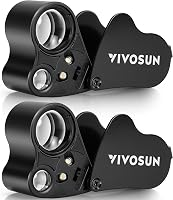
DANOPLUS suits collectors who prefer a classic loupe held to the eye.
Its 10x triplet lens bonds three lenses for color sharpness and clarity, which helps you judge wear and luster accurately.
The 21mm lens diameter gives a workable field for dates and mint marks.
LED and UV light are built in, with a black frame to reduce reflections toward the object.
The aluminum body, pocket size and foldaway design make it easy to carry to shows or coin shops.
At 0.11 kg and under 2 inches long, it fits a pocket or a small pouch.
The kit includes a protective case, lens cleaning cloth and lanyard cord.
That lanyard helps prevent drops when you lean over a display case.
DANOPLUS also includes button batteries and a key for the screw latch.
The trade-off is power and comfort: 10x is the top option here, and long sessions mean holding the loupe to your eye.
If you want a screen, photos or higher magnification, a digital microscope will fit better.
Leipan 4.3" Coin Microscope Coin Magnifier: Best for photo and video records
- 4.3 inch IPS screen
- 50X to 1000X magnification
- Photo and video with one click
- 8 LED lights
- Windows and Mac compatible
A digital coin microscope with a wide magnification range and one-click photo and video, suited to building a visual record of errors and wear.
Pros
- 50X to 1000X range
- 4.3 inch IPS screen
- One-click photo and video
- 8 LED lights
Cons
- No built-in weighing scale
- Battery life details depend on use
Leipan suits collectors who want a record of what they see.
Its 50X to 1000X magnification range lets you move from larger structures to fine detail as you grade.
The 4.3 inch IPS screen gives a generous display for live viewing at a desk.
The 178 degree viewing angle makes it easier to view from the side when sharing with a partner.
One-click photo and video capture helps you document errors, wear patterns and dates for later review or listings.
Eight LED lights provide illumination for close work, and the microscope connects to Windows and Mac for a larger view.
Leipan says battery life is upgraded for extended use.
The plastic body and compact dimensions suit a small desk or a travel kit.
That portability matters if you grade at clubs or in a classroom.
The trade-off is that there is no built-in weighing scale, so weight checks need a separate tool.
It also lacks the side-light and scale combinations of the higher-ranked Elikliv and TOMLOV models.
Choose it for range and recording, and add a scale if weight is part of your grading routine.
Compare the top magnifiers side by side
The table below puts the key specs in one place.
Use it to match magnification, screen, light and extras to your grading style before you read the buying advice.
| Product | Best for | Magnification | Display | Light | Our score |
|---|---|---|---|---|---|
| Elikliv Microscope | detailed coin grading | 1000x | 4.3 inch | 8 adjustable LED lights | 9.7 |
| Elikliv Coin Microscope with Weighing Scale | grading plus weighing | 1000x | 9.5 | ||
| TOMLOV DM4W Microscope with Weighing Scale | stable weighing and viewing | 9.4 | |||
| Amoper 30X Loupe Magnifier Loop Magnifying Glass | high power handheld checks | 30x | 9.2 | ||
| VisionAid 30X 10X Hands-Free Magnifying Glass with | hands-free reading style grading | 30X and 10X | 9.0 | ||
| TOMLOV P10 Microscope for Adults Kids | portable quick checks | 100x fixed, 4X zoom | 8.7 | ||
| Vision Aid 30X 10X Hands-Free Magnifying Glass with | long comfortable sessions | 30X and 10X | 8.5 | ||
| DANOPLUS 10x Magnifier Jewelry Loupe LED UV | a classic pocket loupe | 10x | 8.3 | ||
| Leipan 4.3" Coin Microscope Coin Magnifier | photo and video records | 50X to 1000X | 8.0 |
For a quick scan, start with magnification and screen size.
Digital microscopes cluster around a 4.3 inch screen, while the handheld P10 uses a 2 inch screen.
Loupes have no screen, so you judge them by lens diameter and power.
Then check lighting.
Models with 8 to 10 LEDs and side lights offer more glare control than a basic loupe with a small ring light.
Finally, check extras such as a scale, camera or storage case.
Those extras decide whether one tool replaces two, or whether a simpler loupe plus a separate scale is enough.
How do you choose magnification for coin grading?
Start at 5x to 10x for overall grading, then use 20x to 30x for dates and defects.
That range shows wear on high points and reads mint marks without making the view too small.
Digital microscopes can go far higher, which helps for errors but shrinks the field.
What does 10x show you?
A 10x loupe such as the DANOPLUS triplet shows dates, mint marks and general wear clearly.
It is the classic grading power for a reason.
You can scan a whole coin in sections without losing your place.
When do you need 30x?
Thirty power helps with small text, hairline cracks and fine textures.
The Amoper 30x loupe and the VisionAid models use this level for spot checks.
Expect a small field, so move the coin slowly under the lens.
What about 100x and higher?
Digital models at 100x and above reveal scratches, pitting and error details for photos.
The TOMLOV P10 fixes focus at 100x, while desktop microscopes add adjustable zoom.
Use high power after a lower-power scan, not as your first view.
Loupe, digital microscope or hands-free magnifier: which fits you?
Pick a loupe for speed, a digital microscope for comfort and records, and a hands-free magnifier for field of view.
Many collectors own more than one type.
Your main grading setup should match where and how long you grade.
When a loupe wins
A loupe is light, fast and easy to carry to a show.
The DANOPLUS 10x and Amoper 30x fit in a pocket or case.
You can check a coin in seconds without setting up a stand or screen.
When a digital microscope wins
A screen lets you sit back, share the view and save photos.
The Elikliv and TOMLOV models connect to a computer for a larger image.
This helps for long sessions and for documenting a coin before storage or sale.
If you are unsure between formats, our coin scope or magnifier guide walks through the trade-offs in more detail.
When a hands-free magnifier wins
A large lens on a stand shows more of a coin at once and frees both hands.
VisionAid models suit long sessions and collectors with hand fatigue.
They are weaker for fine defects, so pair one with a loupe for error checks.
Do you need a scale built in?
A built-in scale helps if weight is part of your authenticity and wear checks.
The Elikliv and TOMLOV models weigh to 300g with 0.1g resolution in grams, ounces and carats.
That covers most coins and small jewelry.
Weight does not replace visual grading.
It adds a second check for copies, plated coins and wear over time.
Our guide to gold plated vs 14k gold shows how weight and surface checks work together for precious metal coins.
If you weigh often, a combined tool saves desk space.
If you weigh rarely, a separate best digital scale for weighing coins may be simpler and easier to calibrate.
How to weigh for a cleaner reading
Place the unit on a flat, stable surface before you start.
Use the tare function with an empty tray or holder in place.
That step removes the weight of the holder from the coin reading.
Wait for the display to settle before you record the number.
A stable metal base helps, but a wobbling table can still cause drift.
Weigh in the same unit each time so you can compare readings across sessions.
Grams work well for tracking wear on a single coin over time.
Ounces and carats help when you compare against published specifications or jewelry standards.
How does lighting change what you see when grading?
Adjustable light matters as much as magnification for surface grading.
Direct light flattens relief, while angled or side light reveals wear and scratches.
Dimmable LEDs let you test both views on the same coin.
Digital microscopes in this guide use 8 to 10 LED lights, with side lights on some models to cut glare.
Loupes use smaller LED rings or built-in lights.
UV light helps with some checks, such as currency features, but is not a grading standard for most coins.
Try low light first on proof and shiny coins.
Then raise brightness and change the angle.
Judge luster and wear under more than one light before you grade a coin.
How do you set up and care for a magnifier for grading?
Use a flat stable surface, clean lenses and coins, and store optics in a case.
A wobbling stand blurs fine detail and makes scale readings drift.
Clean a lens with a soft cloth and handle coins by the edge.
For digital microscopes, set the height for the power you need and connect to a computer if you want a larger view.
Save photos with a clear file name that includes the coin type and date.
For loupes, keep the case closed when not in use to protect the lens.
After grading, clean coins only when needed and store them in holders.
Our best ultrasonic jewelry cleaner guide covers cleaning tools for jewelry, while coin cleaning needs separate care.
If you want a digital option for records, our best digital microscope for coin collecting guide compares more screen models.
Verdict: which magnifier should you buy for coin grading?
The Elikliv Microscope is the best magnifier for coin grading for most collectors, thanks to its 4.3 inch screen, 8 adjustable LED lights and adjustable stand.
Pick the Elikliv Coin Microscope with Weighing Scale if you want weight in the same setup.
Pick the TOMLOV DM4W for a taller stand and integrated weighing base.
Pick the DANOPLUS 10x loupe for a classic pocket tool, the Amoper 30x for high-power spot checks, and the VisionAid hands-free models for long comfortable sessions.
Pick the TOMLOV P10 for portable quick checks and the Leipan for photo and video records.
Match the tool to your main task first.
Then check magnification, light control and field of view.
Start with the top pick if you grade at a desk, and add a loupe if you travel to shows.
Our top 3 picks at a glance
-
1
-
2
Best for grading plus weighing
Elikliv Coin Microscope with Weighing Scale
9.5/10 our score
See it on Amazon -
3
Best for stable weighing and viewing
TOMLOV DM4W Microscope with Weighing Scale
9.4/10 our score
See it on Amazon
Frequently asked questions
What magnification do you need for coin grading?
Most grading checks work well at 5x to 10x for overall wear and 20x to 30x for mint marks and small defects. Digital microscopes add higher magnification for errors, but too much power shrinks the field of view.
Choose the lowest power that shows the detail clearly.
Is a loupe or a digital microscope better for grading?
A loupe is faster for quick checks in hand and at shows. A digital microscope with a screen is easier for long sessions and for sharing a view.
Many collectors keep both and match the tool to the coin and the task.
Do you need a scale for coin grading?
Weight helps check authenticity and track wear over time, especially for coins you suspect are copies. It does not replace visual grading of surfaces and strikes.
A combined microscope and scale saves space if you weigh often.
How do you reduce glare on shiny coins?
Lower the LED brightness and change the angle between the light and the coin. Side light can show relief better than direct light on proof surfaces.
Try both white and angled light before you judge a surface.
Can you grade a whole coin under a digital microscope?
Raising the camera and lowering magnification shows more of the coin at once. Most digital models are set up for close detail, so expect a partial view at high power.
A large hands-free magnifier shows more of the coin in one view.