8 Best Gold Panning Kits for Beginners (November 2026)
The best beginner gold panning kit include the ASR Outdoor Lightweight Backpack Gold Panning Kit for backpack prospecting, the Gold Panning Kit with 12" Pocket Sluice for deep-walled pans, and the SE 11-Piece Gold Panning Kit for multiple pan sizes.
On this page (8 sections)
- The best gold panning kits for beginners, by use
- How these kits compare side by side
- How we compared these beginner gold panning kits
- What size pan should a beginner start with?
- Is a sluice box worth it for a beginner?
- What tools matter after you find flakes?
- How should you set up a creek session?
- Which kit should you buy first?
The best gold panning kit for beginners is the ASR Outdoor Lightweight Backpack Gold Panning Kit, because it gives you pans, a mini sluice, a sifter and recovery tools in one pack that weighs 2 lb. That mix matters for a first trip, since you can sample a gravel bar, classify material, pan down concentrates and store flakes without buying more gear later.
A beginner gold panning kit should help you learn the core steps in order. You dig or scoop paydirt, break it down, classify larger material, pan away light sand, pull black sand with a magnet, and save flakes in a vial.
If a kit skips one of those steps, you will feel the gap in the creek.
Our score weighs specs, features and buyer feedback against what a first-time prospector needs. We looked at pan size, sluice length, included recovery tools, weight and how the set packs for travel.
We also checked what each kit does not include, because a missing classifier or magnet changes daily use.
Start with gold panning equipment if you want the wider buying picture before you choose a kit. That guide explains how pans, sluices, classifiers and storage tools fit together.
It can help you avoid paying for tools you will not use on your first trips.
Our picks at a glance
-
1
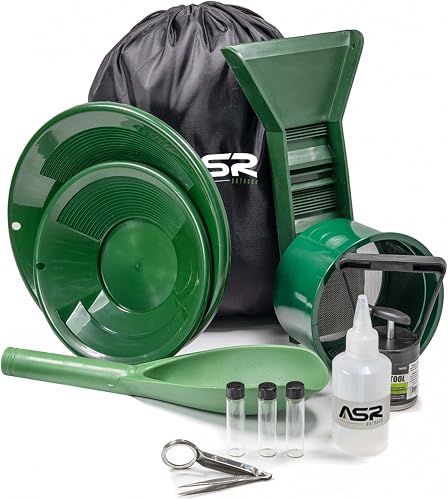 Best for backpack prospecting
ASR Outdoor Lightweight Backpack Gold Panning Kit
9.7/10 our score
See it on Amazon -
2

-
3

- 4
 Check it
DigNew 18pcs Mini Sluice Box Gold Panning
Best for a full accessory set - 5
 Check it
Sluice Fox Gold Rush panning kit with Carry
Best for adults and kids together - 6
 Check it
ASR Outdoor Gold Panning Kit Gold Rush
Best for beginners on a budget - 7
 Check it
Blue Marble Gold Panning Kit with Real
Best for young learners - 8
 Check it
WodGod 18pc Gold Panning Kit with Mini
Best for a longer folding sluice
The best gold panning kits for beginners, by use
The top picks here lead because they cover more of the panning process in one set. A pan-only kit can still be right if you plan to learn in shallow water near home.
A sluice kit can be right if you want to test more material with flowing water.
ASR Outdoor Lightweight Backpack Gold Panning Kit: Best for backpack prospecting
- 14pc kit with 10 inch and 12 inch dual riffle pans
- 12 inch mini sluice box in TPR rubber
- 30 holes per inch sifter
- Drawstring backpack, 2 lb total weight
A complete carry-ready set for beginners who hike to a creek. It covers panning, sluicing, classifying, cleaning and storage without extra purchases.
Pros
- Includes pans, mini sluice, sifter and magnet
- Ready to use with no assembly for the sluice box
- Backpack keeps the set organized
Cons
- Mini sluice is compact, so it suits sampling better than large volume work
- Three riffle patterns may take practice to read
The ASR Outdoor Lightweight Backpack Gold Panning Kit suits beginners who hike to a creek and want one organized pack. It has 10 inch and 12 inch dual riffle pans, so you can use the smaller pan for finishing and the larger pan for bulk work.
The 12 inch mini sluice box is made from TPR rubber with 3 built-in riffle patterns. ASR Outdoor says it is ready to use with no tools or assembly, which helps on a first trip when setup should stay simple.
The kit also has a 30 holes per inch sifter, a brass probe scoop, a black sand magnet tool, tweezers and a drawstring backpack. That list covers classifying, digging, separating black sand and inspecting flakes.
At 2 lb, the set is light enough for a short hike. The mini sluice measures about 12 inches by 3 inches wide with 1.5 inch channel walls, so it fits in a pack and can be attached to gear with a lanyard.
The trade-off is volume, since a 12 inch sluice is best for sampling and clean-up rather than processing large loads. Beginners who want to test many spots will benefit, while those planning long sessions may later add a larger sluice.
Gold Panning Kit with 12" Pocket Sluice: Best for deep-walled pans
- 9 inch and 11 inch spiral riffle pans
- 12 inch pocket sluice box with miners moss
- Gold classifier, snuffer bottle and scoop
- Rubber riffle mat in the sluice box
Deep pans and a pocket sluice make this a strong choice for learning finish panning. It suits beginners who want to work concentrates carefully.
Pros
- Deep-walled pans hold material during swirling
- Pocket sluice works for sampling and clean-up
- Classifier and snuffer bottle support fine gold recovery
Cons
- Pocket sluice is small for high-volume work
- Spiral riffles need a steady, gentle technique
This Sluice Fox kit suits beginners who want deep pans for careful finish panning. The 9 inch and 11 inch spiral riffle pans have deep walls, which give you more room to swirl material without spilling it over the edge.
The 12 inch pocket sluice box has a rubber riffle mat and miners moss. That design traps heavy material while water carries lighter sand away, and the size makes it easy to carry to a gravel bar for a test.
The kit also has a classifier, snuffer bottle and scoop. Those tools help you size material before panning and lift fine flakes from the pan during clean-up.
The classifier is especially useful for removing large rocks that would otherwise crowd the riffles.
A 12 x 4 x 3 inch sluice size keeps the box compact for backpacks. That small footprint suits sampling and home clean-up, where you can run concentrates through still water in a bucket.
The main trade-off is that a pocket sluice is not a high-volume setup. If you want to move larger amounts of gravel, look at longer sluice options in this guide.
SE 11-Piece Gold Panning Kit: Best for multiple pan sizes
- 8 inch, 10 inch and 14 inch dual riffle pans
- Two sifting sieves in 1/2 inch and 1/8 inch mesh
- Magnetic black sand separator pen
- Magnified tweezers, snuffer bottle and glass vials
Three pan sizes let beginners match the pan to the amount of material. Two sieves help classify paydirt before panning.
Pros
- Three pans for small and large loads
- Two mesh sizes for classifying material
- Magnet, tweezers and vials cover clean-up
Cons
- No sluice box for continuous water flow
- 14 inch pan can be awkward in tight creek spaces
The SE 11-Piece Gold Panning Kit suits beginners who like having choice in pan size. It has 8 inch, 10 inch and 14 inch dual riffle pans, so you can match the pan to the load instead of forcing one size to do every job.
The two sifting sieves have 1/2 inch and 1/8 inch mesh. That helps you remove larger rocks before panning and classify material so fine gold is easier to see in the pan.
The sieves stack together and fit over a 5-gallon bucket, which gives you a simple way to build a small classifying station at camp.
Cleaning and storage tools include magnified tweezers, a plastic bottle, a magnetic separator pen, a sand scoop and glass vials. The 5 lb magnetic black sand pocket separator pen targets iron-based black sand that can hide flakes.
A sturdy 12 inch plastic scoop is also included for digging paydirt and river sediment.
At 1.6 lb, it is light for travel. The pans use dual riffles with 3 inch by 1/4 inch deep riffles plus micro riffles, so the design aims to trap flakes while light material washes away.
The trade-off is no sluice box, so this set is for pan work rather than continuous water processing. Beginners focused on learning pan control will find the size range helpful.
DigNew 18pcs Mini Sluice Box Gold Panning: Best for a full accessory set
- 12 inch mini sluice box
- 2 gold pans and 2 classifier screens
- Magnifier tweezers and separating magnet
- 3 snuffer bottles, 3 storage vials and 3 pipettes
An 18 piece set built around a 12 inch aluminum mini sluice. It gives beginners plenty of recovery and storage tools in one pack.
Pros
- Complete set from classifying to storage
- Aluminum sluice frame for creek use
- Multiple bottles, vials and pipettes included
Cons
- 12 inch sluice limits volume compared with longer boxes
- Many small parts need a clear storage routine
The DigNew 18pcs Mini Sluice Box Gold Panning kit suits beginners who want many recovery tools in one set. It has a 12 inch mini sluice box with a 6000-series aluminum frame, plus 2 gold pans and 2 classifier screens.
The accessory list is broad. You get magnifier tweezers, a separating magnet, 3 snuffer bottles, 3 storage vials, 3 pipettes, a paydirt scoop and a drawstring backpack.
Having three of each small bottle and vial means you can separate finds by location instead of mixing flakes from different creeks.
DigNew says the sluice uses dual-layer miners moss with deep ribbed matting and an angled riffle design. In daily use, that means you set it in flowing water, feed classified material at the top, and let heavy particles settle while lighter material washes out.
The stated design targets fine particles down to 50 mesh.
The sluice measures 12 x 3.7 x 1.6 inches, which keeps it portable for hiking. The aluminum frame is described as aircraft-grade and treated for rust resistance, a practical point for repeated creek use.
The trade-off is complexity. With 18 pieces, you need a simple routine for packing and sorting small tools after each trip.
Sluice Fox Gold Rush panning kit with Carry: Best for adults and kids together
- 9 inch and 11 inch spiral riffle pans
- Paydirt scoop, black sand magnet and snuffer bottle
- Magnifier tweezers and 3 glass gold vials
- Drawstring tote, 15.5 oz total weight
A light pan-only kit for a first creek trip with family. It focuses on scooping, panning, separating black sand and saving flakes.
Pros
- Light enough for family backpacks
- Deep pans give room to work each scoop
- Magnet and snuffer bottle help with concentrates
Cons
- No sluice box or classifier screen
- Drawstring tote is simple storage, not a structured case
The Sluice Fox Gold Rush panning kit suits adults and kids who want a light pan-only set. It has 9 inch and 11 inch spiral riffle pans with deep walls, which help beginners keep material in the pan while they learn swirling and shake-down motions.
The kit has a paydirt scoop, black sand magnet, snuffer bottle, tweezers and gold vials. That covers the main recovery steps after panning, from digging material to saving flakes.
The snuffer bottle vacuums flakes straight off the pan, and the stainless magnifier tweezers help you spot pieces too small to grab by hand.
At 15.5 oz, it is the lightest adult-focused option here. It fits easily in a backpack for a short creek visit or a local park with a safe panning area.
The drawstring tote keeps the set together without adding bulk.
The deep pans are described as patented spiral riffle designs that knock out light material fast while holding fine flakes. That matters during finish panning, where a flat-bottom pan can wash away small flakes.
The trade-off is a drawstring tote instead of a structured backpack. You also get no sluice box or classifier screen, so you will rely more on hand panning and manual sorting.
ASR Outdoor Gold Panning Kit Gold Rush: Best for beginners on a budget
- 10 piece beginner kit
- 8 inch and 10 inch dual riffle pans
- 11 inch prospectors trowel
- 8 lb black sand magnet separator and 3 vials
A simple 10 piece kit with pans, a trowel and recovery tools. It suits beginners who want the core tools without a sluice box.
Pros
- Trowel helps dig and move paydirt
- Two pan sizes for different loads
- Magnet and tweezers support final clean-up
Cons
- No sluice box for continuous processing
- Smaller pans may slow work on larger scoops
The ASR Outdoor Gold Panning Kit Gold Rush suits beginners who want core tools with a digging tool included. It has 8 inch and 10 inch dual riffle pans in colors that help flakes stand out against the pan.
The 11 inch prospectors trowel is a useful extra for beginners. It helps you dig through dirt, sand and silt at the edge of a creek instead of using your hands or a pan for every scoop.
The trowel is made of ABS plastic, so it will not rust in wet conditions.
Recovery tools include an 8 lb black sand magnet separator, tweezers with a 4x magnifying glass, water suction tweezers and 3 gold flake vials. Those help you inspect small flakes and store them safely.
Each glass vial holds 3mL and has a water-tight screw lid.
At 14.4 oz, it packs light for day trips. The two pan sizes let you start with the 10 inch pan for bulk work and switch to the 8 inch pan for finishing concentrates in a smaller volume of water.
The trade-off is no sluice box, so this kit is best for learning pan technique and finishing small amounts of material. It suits beginners who want to dig their own paydirt.
Blue Marble Gold Panning Kit with Real: Best for young learners
- Paydirt with real pyrite
- Reusable prospecting pan
- Pipette, tweezers, magnifying glass and specimen dish
- Learning guide on the California Gold Rush
A kid-focused practice kit with real pyrite paydirt and reusable tools. It teaches panning basics before a real creek trip.
Pros
- Real pyrite gives early finds
- Reusable tools for outdoor practice
- Learning guide adds context for kids
Cons
- Pyrite is not gold, so set expectations clearly
- Not built for serious adult prospecting
The Blue Marble Gold Panning Kit with Real Pyrite Pay Dirt suits kids ages 6 and up who want to practice at home. It includes paydirt with real pyrite, so children can find bright specimens while they learn how to sift and swirl.
The reusable tools include a prospecting pan, pipette, tweezers, storage container, magnifying glass and specimen dish. That gives kids a full practice routine without needing creek gear yet.
The eye dropper and specimen dish help children transfer and inspect small finds, which builds the same care they will need with real flakes later.
The learning guide covers the California Gold Rush and fool's gold. That context helps adults explain why pyrite looks like gold but is not the same material.
The included sand with pyrite dust and rock gives each session a fresh set of specimens to find.
At 1.9 lb, it is easy to carry to a backyard or park. The kit is built around STEM learning, so the activity pairs panning motion with geology facts and observation skills.
The trade-off is that pyrite is a teaching material, not a prospecting tool for real gold recovery. Set expectations clearly so kids enjoy the practice without confusion.
WodGod 18pc Gold Panning Kit with Mini: Best for a longer folding sluice
- 27.5 inch folding sluice box
- 2 gold pans and 2 classifier screens
- Magnifier tweezers and separating magnet
- 3 snuffer bottles, 3 vials, 3 pipettes and backpack
A longer folding sluice gives more running room than mini boxes. It suits beginners who want sluice work without a large fixed setup.
Pros
- 27.5 inch sluice offers more processing length
- Folds into a compact carry size
- Full accessory set for recovery and storage
Cons
- Folding design needs checks for leaks and alignment
- Longer setup than a pan-only kit
The WodGod 18pc Gold Panning Kit with Mini suits beginners who want a longer sluice than a mini box. Its 27.5 inch folding sluice box gives water and material more distance to separate, which can help with larger test loads.
The set has 2 gold pans, 2 classifier screens, magnifier tweezers, a separating magnet, 3 snuffer bottles, 3 storage vials, 3 pipettes, a paydirt scoop and a drawstring backpack. The extra classifiers help you sort material before it enters the sluice, which reduces clogging from large rocks and clay.
WodGod says the sluice combines angled mesh, miners moss and carpet matting. In use, you classify material first, then feed it into flowing water so gold settles while lighter sand washes away.
The angled riffles create turbulence that helps heavy particles drop into the matting.
The box folds into a compact size for the carry bag, and the kit uses 6000-series aluminum alloy construction. That material is described as 30 percent lighter than steel, which helps when you hike to a remote creek.
The trade-off is setup time. A folding sluice needs alignment checks and a stable creek position, so it asks more of a beginner than a pan-only kit.
How these kits compare side by side
The comparison table shows the practical split in this group. Some kits focus on pans and hand recovery, while others add a sluice box for water flow.
Choose by how you plan to work, not by piece count alone.
| Product | Best for | Pans | Sluice | Weight | Our score |
|---|---|---|---|---|---|
| ASR Outdoor Lightweight Backpack Gold Panning Kit | backpack prospecting | 10 in and 12 in dual riffle | 12 in mini rubber sluice box | 2 lb | 9.7 |
| Gold Panning Kit with 12" Pocket Sluice | deep-walled pans | 9 in and 11 in spiral riffle | 12 in pocket sluice box | 9.7 | |
| SE 11-Piece Gold Panning Kit | multiple pan sizes | 8 in, 10 in and 14 in | 1.6 lb | 9.6 | |
| DigNew 18pcs Mini Sluice Box Gold Panning | a full accessory set | 2 gold pans | 12 in mini sluice box | 9.6 | |
| Sluice Fox Gold Rush panning kit with Carry | adults and kids together | 9 in and 11 in spiral riffle | 15.5 oz | 9.4 | |
| ASR Outdoor Gold Panning Kit Gold Rush | beginners on a budget | 8 in and 10 in dual riffle | 14.4 oz | 8.9 | |
| Blue Marble Gold Panning Kit with Real | young learners | 1.9 lb | 8.5 | ||
| WodGod 18pc Gold Panning Kit with Mini | a longer folding sluice | 2 gold pans | 27.5 in folding sluice box | 8.2 |
How we compared these beginner gold panning kits
We compared each kit by the jobs it lets a beginner do without buying extra tools. A complete set should cover digging or scooping, classifying, panning or sluicing, black sand separation, flake recovery and storage.
We checked pan size first because control matters more than capacity for new users. A 10 inch to 12 inch pan is easier to learn in a creek than a very large pan.
Smaller pans also help with finishing concentrates at the end.
We checked sluice length next. A 12 inch mini sluice is portable and good for sampling or clean-up.
A 27.5 inch folding sluice gives more room for material but needs more setup and a better water position.
We also weighed pack weight and storage. A 2 lb backpack kit is easy to carry on a trail.
A lighter pan-only kit can fit in a daypack, but you may need to add a classifier or magnet later.
Buyer feedback helped us check real patterns, such as whether deep pans spill less or whether small parts get lost. We used that feedback to adjust scores where a kit looked complete on paper but asked too much from a beginner.
What we left out of the scoring
We did not score kits on price or on claims we could not verify from the product data. That kept the comparison focused on tools, dimensions and included accessories.
We also treated piece count as a weak signal on its own. An 18 piece kit can be complete, but a 10 piece kit can be more practical if every tool earns its place in the pack.
What size pan should a beginner start with?
A 10 inch to 12 inch pan is the best starting size for most beginners. It holds enough material for practice without becoming hard to control in moving water.
Smaller pans for finishing and tight spaces
An 8 inch or 9 inch pan is easier to handle in a narrow creek or at the edge of a pool. It also helps with finishing work, where you want to see fine flakes in a smaller amount of concentrate.
Larger pans for bulk work
A 14 inch pan can hold more paydirt per scoop. That helps when you have a large pile of classified material, but it can be tiring and awkward if the creek bank is uneven.
Dual riffle and spiral riffle designs
Dual riffle pans use two riffle styles to knock out light material and hold fine flakes. Spiral riffle pans guide material around the pan and can help beginners keep flakes from washing out during finish panning.
Is a sluice box worth it for a beginner?
A sluice box is worth it if you want to test more material with flowing water. It is not required for learning basic panning, and a pan is still better for finishing concentrates.
Mini sluice boxes for sampling
A 12 inch mini sluice box fits in a backpack and sets up fast. Use it to test a gravel bar, clean up concentrates at home, or show kids how water separation works.
Longer folding sluice boxes
A longer box gives material more time to settle. It also needs a steady flow, a level position and periodic checks to clear rocks and clay.
When to skip the sluice for now
Skip a sluice if you will mostly work in still water, a tailings pile or a small bucket. In those settings, pans, sieves and a magnet do more of the work.
What tools matter after you find flakes?
Recovery tools matter because fine gold is easy to lose during clean-up. A magnet, tweezers or snuffer bottle, and vials turn a pan of black sand into a keepsake you can inspect.
Black sand magnets
A black sand magnet pulls magnetic material away from gold. That step makes flakes easier to see and reduces the amount of concentrate you need to inspect by hand.
Tweezers and snuffer bottles
Magnifying tweezers help you lift flakes that are too small to grab with fingers. A snuffer bottle uses suction to lift flakes from water in the pan.
Vials and storage
Glass vials keep flakes dry and contained. Label the vial with the location and date, since that record helps you learn which gravel bars produced fine gold.
How should you set up a creek session?
Set up in a safe spot with shallow water, room to kneel or sit, and a place to stage classified material. Keep your pan, classifier and vial within reach so you do not set wet tools on the ground.
Classify before you pan
Remove large rocks and clay before panning. That step saves time and helps you see gold sooner, because large material can hide flakes in the riffles.
Work in small batches
Pan one scoop at a time until the motion feels natural. Small batches teach you how water speed, pan angle and shake-down timing affect recovery.
Finish concentrates slowly
Move the last black sand and flakes into a smaller amount of water. Use gentle swirls and sharp shake-downs, then lift flakes with tweezers or a snuffer bottle.
Which kit should you buy first?
Buy the ASR Outdoor Lightweight Backpack Gold Panning Kit if you want one complete set for hiking and creek work. It has the widest tool range here, including pans, a mini sluice, a sifter and a magnet.
Buy the Gold Panning Kit with 12 inch Pocket Sluice if deep pans matter more to you. The 9 inch and 11 inch pans give you more room for finish panning, and the pocket sluice supports sampling.
Buy the SE 11-Piece Gold Panning Kit if you want three pan sizes and two sieves. It is a strong pan-focused choice for beginners who want to classify material before panning.
Buy the Blue Marble kit for kids who need practice first. It teaches the motion with real pyrite, then you can move to a real creek kit when they are ready.
Parents should also check best gold panning for kids before choosing a family kit. That guide helps you match tool size and activity level to a child's age.
If you want more ASR Outdoor options, read best asr outdoor gold panning. That roundup tracks other kits from the same brand and how they differ from the top pick here.
For a deeper look at one complete set, see the minelab pro gold panning kit review. It helps you compare a named review pick with the broader beginner options in this guide.
If you are still deciding between hobbies, Is Metal Detecting a Real Hobby? A Beginner’s Guide explains how detecting and panning can fit together.
Some beginners use a detector to scout ground, then pan where conditions look promising.
After panning, you may want to know how to sort finds. what is best metal classifier for gold covers classifiers that help separate material before final clean-up.
Our top 3 picks at a glance
-
1
Best for backpack prospecting
ASR Outdoor Lightweight Backpack Gold Panning Kit
9.7/10 our score
See it on Amazon -
2
-
3
Frequently asked questions
What should a beginner gold panning kit include?
A beginner gold panning kit should include at least one riffled pan, a scoop or classifier, a magnet for black sand, tweezers or a snuffer bottle, and a vial for flakes. A small sluice box is useful if you want to process material with flowing water rather than only swirling a pan by hand.
Is a sluice box better than a pan for beginners?
A pan is better for learning control and for finishing concentrates. A sluice box is better for moving more material with water flow.
Many beginners start with pans, then add a small sluice once they understand classification and clean-up.
What size gold pan should a beginner choose?
A 10 inch to 12 inch pan is a practical starting size for most creeks. Smaller pans help with tight spaces and finishing work.
Larger pans hold more material but can be harder to control in current or on uneven ground.
How do you clean gold flakes after panning?
Remove magnetic black sand with a separator magnet, then lift flakes with tweezers or a snuffer bottle. Store dry flakes in a vial with a tight lid.
Keep concentrates separate until you finish panning, because early clean-up can lose fine flakes.
Can kids use a beginner gold panning kit?
Yes, if the kit uses simple tools and clear supervision. A practice kit with pyrite paydirt helps kids learn technique at home.
For creek trips, choose light pans and short sessions, and teach kids to leave no trace.


