7 Best Fins for Underwater Metal Detecting (November 2026)
The best fins for underwater metal detecting include the FINIS Long Floating Swim Fins for buoyant swim training, the Cressi Adult Snorkeling Full Foot Pocket Fins for snorkeling searches, and the Cressi Short Full Foot Pocket Fins for compact kicking.
On this page (8 sections)
- How we chose fins for underwater metal detecting
- The best fins for underwater metal detecting by use
- What fin length works best for controlled movement?
- How can you keep from stirring up sediment?
- What foot-pocket style should you choose?
- How should you match fins to your search site?
- How do fins fit into a complete detecting setup?
- Which fins should you choose for underwater metal detecting?
The best fins for underwater metal detecting help you move with control while limiting disturbance to the bottom. Short blades are easier to handle in tight areas, while longer blades can provide more propulsion in open water.
Your fin choice should match your search zone, footwear and comfort in the water. The picks below include swim-training, snorkeling and diving styles, since each offers a different balance of blade length and foot coverage.
Before choosing gear, read our guide to whether a metal detector can detect underwater. Your detector's water rating and depth limits shape where you can safely use it.
Our picks at a glance
-
1

-
2
 Best for snorkeling searches
Cressi Adult Snorkeling Full Foot Pocket Fins
9.5/10 our score
See it on Amazon -
3

- 4
 Best for quick, short kicksCheck it
- 5
 Best for a size-specific fitCheck it
- 6
 Check it
IST Rubber Rocket Scuba Diver Fins
Best for bootie-compatible diving - 7
 Check it
Seac Motus Long Free Diving Soft
Best for long-blade freediving
How we chose fins for underwater metal detecting
We compared blade style, foot-pocket design and intended use to identify options that may suit different underwater search conditions. No single fin style is best for every site, since a confined shoreline search calls for different movement than open water.
A short blade can make it easier to reposition and turn with small kicks. A longer blade is designed for propulsion, but it takes more space and can move more water with each kick.
Foot fit matters because a loose or uncomfortable fin can distract you from controlling your detector. Decide whether you plan to wear a bare foot, swim sock or dive bootie, then choose a foot-pocket style that matches.
These picks are swim, snorkeling and diving fins, not metal-detecting-specific models. Use them only where their fit and intended activity suit your conditions, and follow local water-safety rules.
Our score weighs specs, features and buyer feedback against what you're shopping for.
| Product | Best for | Blade | Material | Closure | Our score |
|---|---|---|---|---|---|
| FINIS Long Floating Swim Fins | buoyant swim training | Long | Rubber | Pull-on | 9.7 |
| Cressi Adult Snorkeling Full Foot Pocket Fins | snorkeling searches | Soft and flexible | Pull-on | 9.5 | |
| Cressi Short Full Foot Pocket Fins | compact kicking | Short | Thermoplastic and rubber elastomer | 9.3 | |
| TYR Stryker Silicone Fins | quick, short kicks | Short | Silicone | 9.1 | |
| TYR Burner Swim Fins 2.0 | a size-specific fit | Natural rubber | 8.6 | ||
| IST Rubber Rocket Scuba Diver Fins | bootie-compatible diving | Rubber | Buckle | 8.3 | |
| Seac Motus Long Free Diving Soft | long-blade freediving | Long, interchangeable | 7.9 |
The best fins for underwater metal detecting by use
The right pick depends on whether you value propulsion, compact kicking or bootie compatibility most. Use the short descriptions below to narrow the list before comparing fit and blade shape.
FINIS Long Floating Swim Fins: Best for buoyant swim training
- Long rubber blade
- Designed for buoyancy and forward propulsion
- Pull-on closure
A long rubber blade and buoyant design suit swimmers who want forward propulsion. Consider the extra blade length when planning close turns over a search area.
Pros
- Long blade for forward propulsion
- Designed to lift legs toward the surface
- Floats in fresh and saltwater
Cons
- Long blade may take more room to maneuver in a confined search area
FINIS Long Floating Swim Fins are the strongest fit here if you want a long blade designed for buoyancy and forward propulsion. The rubber blade is intended to help lift the legs toward the water's surface, which can support a more horizontal swimming position.
That design makes them more suited to covering open water than making repeated tight turns over a small patch. A long blade needs room to move, so keep kicks measured when you are close to the bottom or another person.
The pull-on style keeps the design simple, but you'll want to confirm the fit for your foot before a long session. FINIS recommends rinsing the fins in cool, non-chlorinated water and air-drying them away from extended direct sun.
Choose these if forward movement is your priority and your search area gives you room to maneuver. For compact searches around rocks or in shallows, a short blade may be easier to control.
Cressi Adult Snorkeling Full Foot Pocket Fins: Best for snorkeling searches
- Full foot pocket
- Soft, flexible polypropylene blade
- Heel pull-tab
These adult snorkeling fins pair a flexible blade with a full foot pocket. The heel pull-tab can make putting them on and taking them off easier.
Pros
- Flexible blade
- Heel pull-tab
- Designed for snorkeling and swimming
Cons
- Closed foot pocket may not suit every boot or sock setup
The Cressi Adult Snorkeling Full Foot Pocket Fins suit snorkel-style searches where you want a flexible blade and a covered foot. The blade is made from soft, flexible polypropylene, and the foot pocket combines with the blade as one piece.
A heel pull-tab can help when putting the fins on or taking them off. This can be useful when you're gearing up beside the water, though the full foot pocket won't work over every boot or sock.
Cressi describes these fins for snorkeling and swimming, with a design intended to be easy to use. They may suit a detectorist who wants a middle ground between long propulsion fins and compact training fins.
Check the fit with the footwear you intend to use before you head out. For a separate tool used on the shore, see our guide to the best magnet for metal detecting.
Cressi Short Full Foot Pocket Fins: Best for compact kicking
- Short blade
- Soft rubber elastomer foot pocket
- Designed for swim training and pool use
A short blade supports agile kicking and is easier to manage where space is limited. The soft elastomer foot pocket is designed for comfort during longer swim sessions.
Pros
- Short blade for agile kicking
- Soft foot pocket
- Designed for pool training, swimming and snorkeling
Cons
- Short blade prioritizes agility over the longer blade styles
The Cressi Short Full Foot Pocket Fins are a practical choice when compact kicks and easier maneuvering matter most. Their short blade is designed for agile kicking, and the model is intended for pool training, recreational swimming and snorkeling.
A shorter blade can feel more manageable as you turn or hold position near a target. It also gives up some of the longer blade's emphasis on forward propulsion, so it may be less appealing when you need to cover a broad area.
The foot pocket is made from soft rubber elastomers and is designed for comfort during longer swim sessions. The short profile may also make entry and exit from the water easier than with a long freediving blade.
Choose this style for close-range work in calmer water where controlled movement matters more than speed. Pair it with well-fitting gloves for handling finds and gear; our guide to the best gloves for metal detecting covers options for that part of the setup.
TYR Stryker Silicone Fins: Best for quick, short kicks
- 100% silicone construction
- Short blade
- Non-slip footpad
These short-blade silicone fins are designed to promote quick leg and foot movement. Their non-slip footpad is intended for footing around boats and docks.
Pros
- Short blade for quick movement
- Silicone construction
- Non-slip footpad
Cons
- Sizing varies by shoe size
TYR Stryker Silicone Fins are designed for short, quick movement through the legs and feet. Their short blade and silicone construction make them a plausible option for a detectorist who prefers a compact kick over a long, propulsive stroke.
A non-slip footpad is intended to help with footing around boats, docks and poolside surfaces. It doesn't replace care on wet or uneven ground, so move slowly when entering or leaving the water.
The fit varies by shoe size, and the listed medium size covers men's shoe sizes 6–7 and women's 7.5–8.5. Check your size before choosing a pair, especially if you plan to wear socks.
These fins make the most sense when maneuverability is a priority and the size range works for you. They're designed to promote a natural flutter kick, so practice using small movements before searching a silty area.
TYR Burner Swim Fins 2.0: Best for a size-specific fit
- 100% natural rubber
- Thickened foot pockets
- Universal no-slip heel grip
The Burner 2.0 has thickened foot pockets and a no-slip heel grip. Its size guidance includes men's and women's shoe-size ranges, with fit advice for wider or narrow feet.
Pros
- Size range from XS to XL
- Thickened foot pockets
- No-slip heel grip
Cons
- A full foot pocket may not fit over dive booties
TYR Burner Swim Fins 2.0 suit buyers who want a full foot pocket with size guidance across a broad range. The fins use natural rubber, have thickened foot pockets and include a no-slip grip on the heel base.
TYR recommends sizing up if you're between sizes or have a wider foot, and sizing down if your foot is narrow. That guidance makes sizing worth checking before a trip, since an uncomfortable fit can make it harder to focus on detector control.
These are swim-training fins with short, quick movement in mind. Their full-foot design is less suited to wearing over dive booties, so consider the open-back IST option if bootie compatibility is essential.
Choose the Burner 2.0 if the size range and enclosed foot fit match your setup. For clothing and other shore-side gear, our best metal detecting t shirt guide offers a related option.
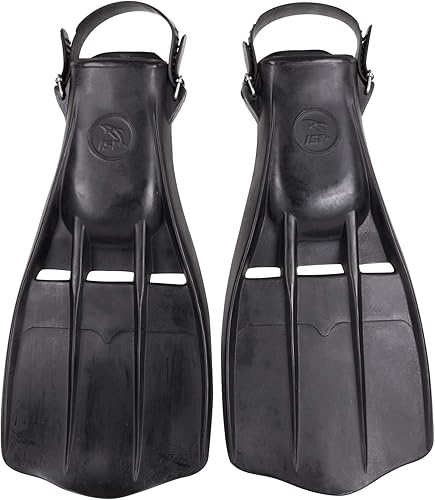
IST Rubber Rocket Scuba Diver Fins: Best for bootie-compatible diving
- Open-back design
- Designed for dive booties
- Curved, tapered blade
The open-back design is made to be worn with dive booties. Its curved, tapered blade and deep grooves are designed to channel water for propulsion.
Pros
- Open back for dive booties
- Curved, tapered blade
- Deep water-channeling grooves
Cons
- Heavier than the swim-training options
The IST Rubber Rocket Scuba Diver Fins stand out for an open-back design made to be worn with dive booties. That can make them a better fit when foot coverage is part of your water setup.
The curved, tapered blade and deep grooves are designed to channel water backward for propulsion. They are scuba fins with a heavier rubber build, so expect a different feel from the short swim-training options.
This style may suit deeper or more open water where booties and a powerful kick are useful. In a confined search zone, a larger fin can make careful turning and bottom awareness more challenging.
Choose them when bootie compatibility is your main need and you have room to maneuver. Check that the buckle and bootie fit work together before entering the water.
Seac Motus Long Free Diving Soft: Best for long-blade freediving
- Long freediving blade
- Interchangeable techno-polymer blade
- 22-degree blade-to-foot angle
These long freediving fins use an interchangeable blade made from techno-polymer. The closed-shoe design and long blade suit open-water propulsion more than tight turns.
Pros
- Interchangeable blade
- Closed-shoe design
- Angled blade for thrust
Cons
- Long blade can be less convenient in confined areas
The Seac Motus Long Free Diving Soft fins are designed for long-blade freediving. Their interchangeable techno-polymer blade and 22-degree angle between the blade and foot are intended to support thrust with less effort.
A long blade suits open-water travel better than close turns around a small target. It can be harder to keep clear of rocks, weeds or the bottom in a tight search space, so choose a shorter fin for confined areas.
The closed-shoe foot pocket is another fit point to consider. It differs from the open-back IST design made for dive booties, and may be a better match if you prefer a closed foot.
Choose the Motus when long-blade propulsion is your main priority and your search zone is open enough for it. If your search includes exposed shorelines, our best metal detector harness guide can help you consider how to carry detector weight between water sessions.
What fin length works best for controlled movement?
Short fins are usually easier to maneuver in a small search area because their blades take up less space. They can support quick, compact kicks when you need to reposition without sweeping a long blade through the water.
Long fins are designed to create more propulsion, which can help when moving across open water. They require more room and can move more water, so use a light kick and keep a safe distance from the bottom.
There is no universal length that prevents sediment disturbance. The best practical choice is the shortest fin that gives you enough movement for the water conditions and your comfort.
How can you keep from stirring up sediment?
Keep your kicks small, slow and angled away from the bottom. Large kicks can push water and sediment into the area you're trying to scan, reducing visibility around the coil.
Hold your body position steady and avoid scraping the bottom with your fins. If a cloud of silt rises, pause movement until visibility returns instead of continuing to sweep through it.
A detector's signals can be harder to interpret when you have to move quickly to regain position. Our guide to conductivity in metal detecting explains how conductivity relates to target signals.
What foot-pocket style should you choose?
Choose a full foot pocket if you prefer a covered foot and don't need to wear a dive bootie inside the fin. Short full-foot options can also reduce how much blade extends beyond your foot.
Choose an open-back design when you plan to wear dive booties. The IST Rubber Rocket is specifically designed for that arrangement, while the other full-foot designs listed here may not fit over booties.
Fit can vary by brand and size, so try your planned combination of fin and footwear before a long trip. A fin that shifts or pinches can distract you from maintaining steady movement.
How should you match fins to your search site?
For shallow, confined areas, prioritize a compact blade and a secure fit that lets you make small kicks. Avoid long blades if you have little room to turn or need to pass close to rocks and vegetation.
For deeper or open water, longer blades may suit the extra travel distance, provided you're comfortable managing the added blade length. If you plan to use a detector underwater, first confirm the detector's depth rating and controls.
Think about entry and exit too. A fin that works in open water can be awkward on a rocky shore, so take it off before walking over uneven ground if its shape affects your footing.
How do fins fit into a complete detecting setup?
Fins help with movement, while your detector and carry gear affect how easily you can keep a stable search pattern. Keep your equipment secure and arrange it so you can reach controls without making sudden movements.
A well-fitted mask or snorkel may matter for some shallow-water searches, but only use gear suited to your skill and conditions. Follow local rules, check weather and currents, and avoid entering water that exceeds your training.
For the fins themselves, choose short blades for close maneuvering, longer blades for open-water propulsion and an open-back style when you need dive booties. A controlled kick and a suitable search area matter as much as the fin choice.
Which fins should you choose for underwater metal detecting?
Choose Cressi Short Full Foot Pocket Fins or TYR Stryker Silicone Fins for compact movement and easier turns in a confined area. Pick the IST Rubber Rocket when you need an open back for dive booties, and consider the FINIS Long Floating Swim Fins or Seac Motus for open-water propulsion.
Match the fin to your footwear and search site, then keep your kicks small to reduce disturbance near the bottom. Before you go, confirm that your detector is designed for the depth and conditions you plan to enter.
Our top 3 picks at a glance
-
1
-
2
Best for snorkeling searches
Cressi Adult Snorkeling Full Foot Pocket Fins
9.5/10 our score
See it on Amazon -
3
Frequently asked questions
Are long or short fins better for underwater metal detecting?
Short fins are often easier to maneuver when you need to turn or hold position over a small search area. Longer fins are designed to provide more propulsion, which can help in open water, but they need more room to move.
Choose the blade length that lets you move steadily without scraping or stirring the bottom.
Can fins help reduce sediment disturbance?
Fins can help you control your movement, but technique matters too. Keep your kicks small and slow, and avoid pushing water directly at the bottom.
If visibility drops, stop kicking and let suspended sediment settle before continuing your search.
Should I wear dive booties with metal detecting fins?
That depends on the fin's foot pocket. Open-back fins such as the IST Rubber Rocket are designed for dive booties, while full-foot designs cover the foot and may not fit over them.
Check the fit with your planned socks or booties before entering the water.
Can I use swim-training fins for underwater detecting?
Yes, swim-training fins may suit calm, shallow searches where you want compact movement. Short-blade options are designed for agile or quick kicking, while longer swim fins are built for forward propulsion.
Match the fin to your water conditions and make sure you can maneuver without disturbing the bottom.


